Setup & Safe Storage · Guide
Where to put a gun safe in your house: garage, closet, bedroom or basement
Every spot trades one risk for another. Here is how the common locations compare on humidity, fire, access, concealment and floor load, and what to check before the safe arrives.
By Mike M.Updated Researched, not lab-tested
#adReader-supported: we may earn a commission if you buy through our links, at no extra cost to you. It never decides a ranking. How we rate · Disclosure
A full-size gun safe is close to permanent once it's in place: hundreds of pounds, bolted to the floor, and a real job to move. So the location decision deserves the same care as the safe itself. There is no perfect spot. There is a spot whose trade-offs fit your house, your household and the threat you're most worried about. This guide is about large gun safes; for small home safes, where concealment matters more than floor load, see our guide to where to put a safe in your house.
The five tests every location has to pass
- Humidity and temperature. Steel and wood suffer in damp air and big temperature swings. Liberty Safe, citing the NRA, puts the target at 30 to 50 percent humidity and 70°F or below.
- Fire. A gun safe's fire rating is a time limit, and for most gun safes we cover it is a figure the maker measured itself. A location that lets a fire grow before anyone notices uses up that time faster. Our fire ratings explainer covers what the numbers mean.
- Access. How quickly the right adult can reach it, and how easily the wrong person (a child, a guest, a contractor) can see it or get to it.
- Concealment. A safe nobody knows about is a safe nobody plans for. Liberty's anchoring guide suggests choosing a spot that is structurally sound and discreet, and names a corner in a closet or basement as often ideal.
- Floor load and anchoring. The floor has to carry the weight, and the safe has to be bolted to something solid. Liberty's relocation guide calls basements or ground floors with concrete subflooring ideal for a heavy safe.
Weigh the five in the order of your household's real risks. With children in the house, access control comes first and the safe belongs where adults can reach it and children can't get into it. In a humid climate, moisture works on the collection every day, while a burglary is an occasional risk. And in an older house with an upstairs bedroom, the floor may make the decision for you before any of the other tests come into play.
The common locations compared
This table summarizes the trade-offs from the sources below. It is a starting point; your own house (a dry, finished basement versus a damp one, a slab-on-grade bedroom versus an upstairs one) can move any cell.
| Location | Humidity | Fire | Access | Concealment | Floor and anchoring |
|---|---|---|---|---|---|
| Garage (unconditioned) | Poor: big heat and cold swings | Weak point: garage fires tend to grow larger (USFA) | Easy for adults; often open to the street | Poor when the door is up | Often concrete; good for anchors |
| Basement | Watch closely: damp basements and concrete add moisture | No sourced advantage; rely on the safe's rating | Slower: stairs between you and it | Good | Best: concrete carries weight and takes anchors |
| Bedroom or bedroom closet | Good: conditioned living space | No sourced advantage; rely on the safe's rating | Fastest for adults; also where children look | Good in a closet | Depends on the floor: check upstairs |
| Main-floor room or office | Good: conditioned living space | No sourced advantage; rely on the safe's rating | Good | Fair: visible to visitors | Good on a slab; check a framed floor |
The garage
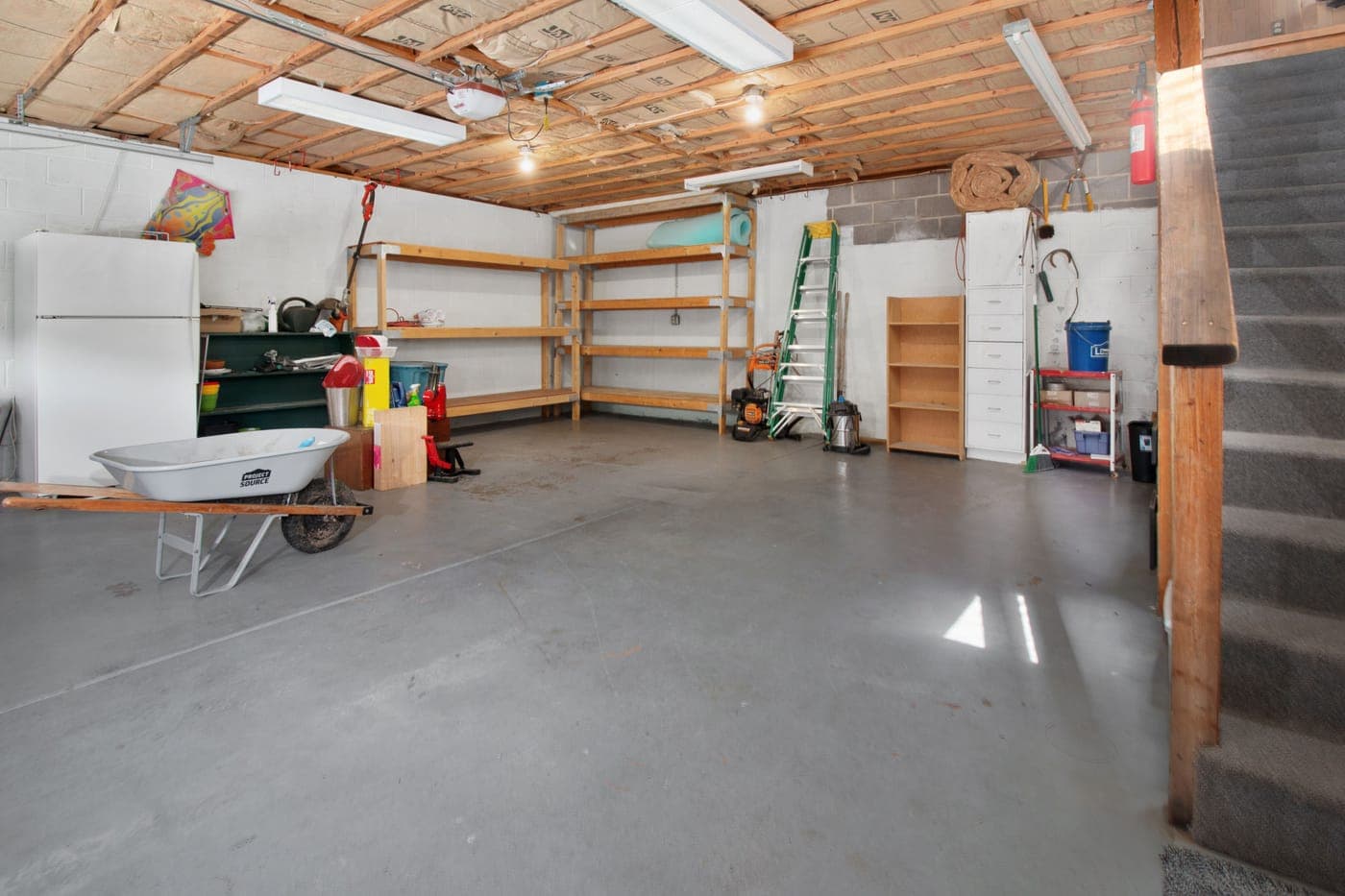
The garage is the default for many owners because it's easy to deliver into and often has a concrete floor. On evidence, it is the weakest location of the four.
Humidity: Liberty's humidity article says a non-climate-controlled garage, where temperatures can exceed 100°F in summer and fall below freezing in winter, is not an ideal place to store firearms, because radical temperature changes can cause condensation.
Fire: A U.S. Fire Administration report on residential garage fires found that fires starting in residential garages tend to be larger and spread farther than fires that start elsewhere in a home. It notes that few, if any, building codes require smoke alarms in residential garages, so detection takes longer, and that garages typically hold fuel sources such as flammable liquids, paint and chemicals. A fire-rated safe buys time; a location where fires grow unnoticed spends it.
Access and concealment: An open garage door puts the safe on display to the street, and garages are where visitors and service workers come and go.
If the garage is the only option, stack the odds: choose a safe with the strongest fire evidence you can get, anchor it, keep the door shut, add a dehumidifier and a hygrometer, and keep it away from the fuel and chemicals the USFA report describes.
The basement
For weight and anchoring, a basement is hard to beat. Concrete carries a heavy safe without the floor-load questions an upper story raises, and concrete anchors are the hardware makers write their bolt-down instructions for.
The catch is moisture. Liberty's humidity article puts a musty basement where water condenses on the walls and floor in the same "not ideal" category as the garage, and its environmental-control guide notes that concrete can contribute to moisture problems and that basement owners should monitor seasonal humidity changes. A finished, conditioned basement is a different room from a damp, unfinished one, and the hygrometer will tell you which you have.
A bedroom or bedroom closet
A bedroom closet is conditioned living space (good for humidity), easy to conceal, and the fastest place for an adult to reach. It is also where children look. The American Academy of Pediatrics' guidance for parents notes that many children who died in unintentional shootings at home had found the gun, usually a handgun, in a nightstand or other sleeping area. A locked safe changes that, but only if it stays locked and the key or code stays with adults. Our guide to storing guns safely with kids covers the layers.
The other bedroom question is weight. Many bedrooms are upstairs, on wood-framed floors, and the model residential code sets a lower minimum design load for sleeping rooms (30 pounds per square foot) than for other rooms (40), per Table R301.5 as adopted in state codes such as Washington's. A lighter safe in a closet corner is usually a straightforward decision; a heavy one upstairs deserves the checks in our guide to whether your floor can support a gun safe.
A main-floor room or office
A ground-floor room, home office or spare-room closet often scores well on every test: conditioned air, a floor that is either slab or close to its supports, and a reasonable walk from the bedrooms. The trade-off is concealment. A full-size safe in a room guests pass through announces itself, so a closet or a corner out of sight lines is worth the effort.
The main floor also tends to be the easiest delivery: fewer stairs, and often a straight path from the door. That matters more than it sounds, because every stair and tight turn between the truck and the final spot adds risk for whoever is moving a several-hundred-pound safe.
Apartments, condos and rentals
If you rent or live in a multi-unit building, the choice narrows. Anchoring means drilling, which is a lease question, so get the landlord's permission in writing before the safe arrives. The floor is usually a framed or shared structure you can't inspect, so a heavy safe on an upper floor is a question for building management, not just for you. And stairs or small elevators limit what can be delivered at all.
That usually points to a lighter safe in a closet, or a cabinet that assembles in the room and anchors to wall studs where the maker allows it. Our best gun safes for apartments ranks the options for exactly this situation.
One safe or two?
Many households don't need one location to do everything. A common split is a large safe for long guns and anything not needed quickly, in the location that best handles weight, humidity and fire, plus a small quick-access safe for a home-defense handgun, bolted down in the bedroom. The big safe goes where the floor and the air are right; the small one goes where speed matters. Each stays locked. Our best bedside gun safes covers the second half of that setup.
Splitting storage also eases the floor question. A handgun safe weighs a small fraction of a full-size gun safe (the Vaultek MX Series, one of the larger ones, is 32 pounds), so it can go upstairs in a bedroom while the heavy safe stays on a slab.
Where in the room
Once you've picked the room, the exact spot still matters:
- Away from exterior walls and vents. Liberty's environmental guide warns that an exterior wall can run cooler than the room (inviting condensation) and that direct blasts from heating and cooling vents cause quick temperature swings.
- Near a bearing wall on a framed floor. On an upstairs or framed floor, the strongest spot is close to a load-bearing wall with the safe's base crossing several joists. The floor-support guide explains why.
- Room for the door. Measure the door's full swing, and remember that an open door shifts the safe's center of gravity forward, which is one more reason to anchor it.
- An outlet within reach. A plug-in dehumidifier rod or safe lighting needs power through the safe's pass-through, so plan the outlet before the safe is bolted down.
- Nothing underneath to hit. Liberty's relocation guide says to check for radiant heating, pipes and wiring before drilling anchor holes.
Two safes for two common spots
If you're choosing the safe and the spot together, the location narrows the field. A closet or bedroom favors a narrow, lighter footprint; a basement that has seen water favors a safe with a water claim and a sealed bolt-down kit. Our best gun safes ranking covers the whole field on evidence; these two fit the two most common placements.
Our picks for this
Matched to the spot
One for a closet or bedroom, one for a basement. The first carries a maker-stated UL RSC listing; the second does not, and we say so on its card.
 Stock photo
Best compact UL RSC gun safe
Stealth UL14
UL RSC7.4/10For a closet or bedroom: maker-stated UL RSC listing in a 20 x 17 in footprint at 365 lb, with 4 pre-drilled bolt-down holes.
Check price · Amazon#ad · Price set by Amazon · Disclosure for the link to Stealth UL14
- Stock photo
Best for flood-prone basements (maker water claim)
Sports Afield Haven SA5930HX
Access box5.0/10For a basement that has taken on water: the only safe in our registry with a published water claim (maker-stated, no lab named) and a waterproof bolt-down kit. No UL burglary listing.
Check price · Amazon#ad · Price set by Amazon · Disclosure for the link to Sports Afield Haven SA5930HX
A before-delivery checklist
- Put a hygrometer in the spot for a week and read the highs and lows.
- Measure the delivery path: doors, halls, stair turns, and the safe's depth including the handle.
- Confirm the floor: slab, or a framed floor you have checked or had checked for the safe's weight.
- Find what's under the floor before anyone drills (pipes, wiring, radiant heat).
- Plan power for a dehumidifier or light.
- Decide who will move and anchor it; for heavy safes and stairs, that should be professionals.
Then keep the humidity in range with moisture control matched to the spot: a plug-in rod where the safe has power, a rechargeable unit where it doesn't.
How we scored this
Safes we claim to have lab-tested: 0
Plenty of sites say they drilled, burned and flooded every safe they list. We didn't, and we say so. What we do instead: check whether an independent lab listed the safe (UL for burglary under UL 1037, UL or Intertek for fire), read the maker's published steel, lock and bolt-down specs, search CPSC recalls, and score every pick on a public rubric. Every figure links to where it came from.
Scores are editorial judgments from that documented research, not lab results. Commissions never set a score or decide a pick. The rubric and its weights are published.
Questions
Frequently asked
Where is the best place to put a gun safe in your house?
Is it OK to keep a gun safe in the garage?
Can I put a gun safe in my bedroom?
Is a basement a good place for a gun safe?
Should a gun safe go against an outside wall?
Can I put a gun safe on the second floor?
Keep reading
Related on Bolt & Vault
- How to bolt down a gun safeAnchoring on concrete, wood or carpet once the spot is chosen.
- Can your floor support a gun safe?Weight, footprint and second floors.
- Gun safe humidity levelsThe 30-50% target and how to hold it.
- Where to put a home safePlacement for smaller home and wall safes.
- How to move a gun safeGetting it to the spot without injury.
Receipts
Sources
- Liberty Safe — The Impact of Humidity on Firearms (checked 2026-09-19)
- Liberty Safe — Safe Environmental Control: Managing Temperature and Humidity Inside Your Safe (checked 2026-09-19)
- Liberty Safe — Preventing Safe Tipping: Best Practices for Anchoring Gun Safes (checked 2026-09-19)
- Liberty Safe — Safe Relocation 101 (checked 2026-09-19)
- U.S. Fire Administration — Residential Building Garage Fires (2009-2011), Topical Fire Report Series Vol. 14 Issue 12 (PDF, checked 2026-09-19)
- Washington State Legislature — WAC 51-51-0301, Table R301.5 Minimum uniformly distributed live loads (checked 2026-09-19)
- American Academy of Pediatrics (HealthyChildren.org) — Guns in the Home: How to Keep Kids Safe (checked 2026-09-19)
We don't lab-test safes and we don't pretend to. Ratings come from the listing body or the maker's own spec pages (linked on every product), recall status from CPSC searches, and law summaries from official sources. Prices are set by Amazon and change often, so we don't print them. Where a figure isn't published, we say so. Read the full method.