Setup & Safe Storage · Guide
Can a gun safe be laid down? Every published method keeps it upright
The question usually arrives with a pickup truck and a staircase. The honest answer is that makers do not publish a flat-transport procedure, and the method they do publish is a dolly, tipped back, with help.
By Mike M.Updated Researched
#adReader-supported: we may earn a commission if you buy through our links, at no extra cost to you. It never decides a ranking. How we rate · Disclosure
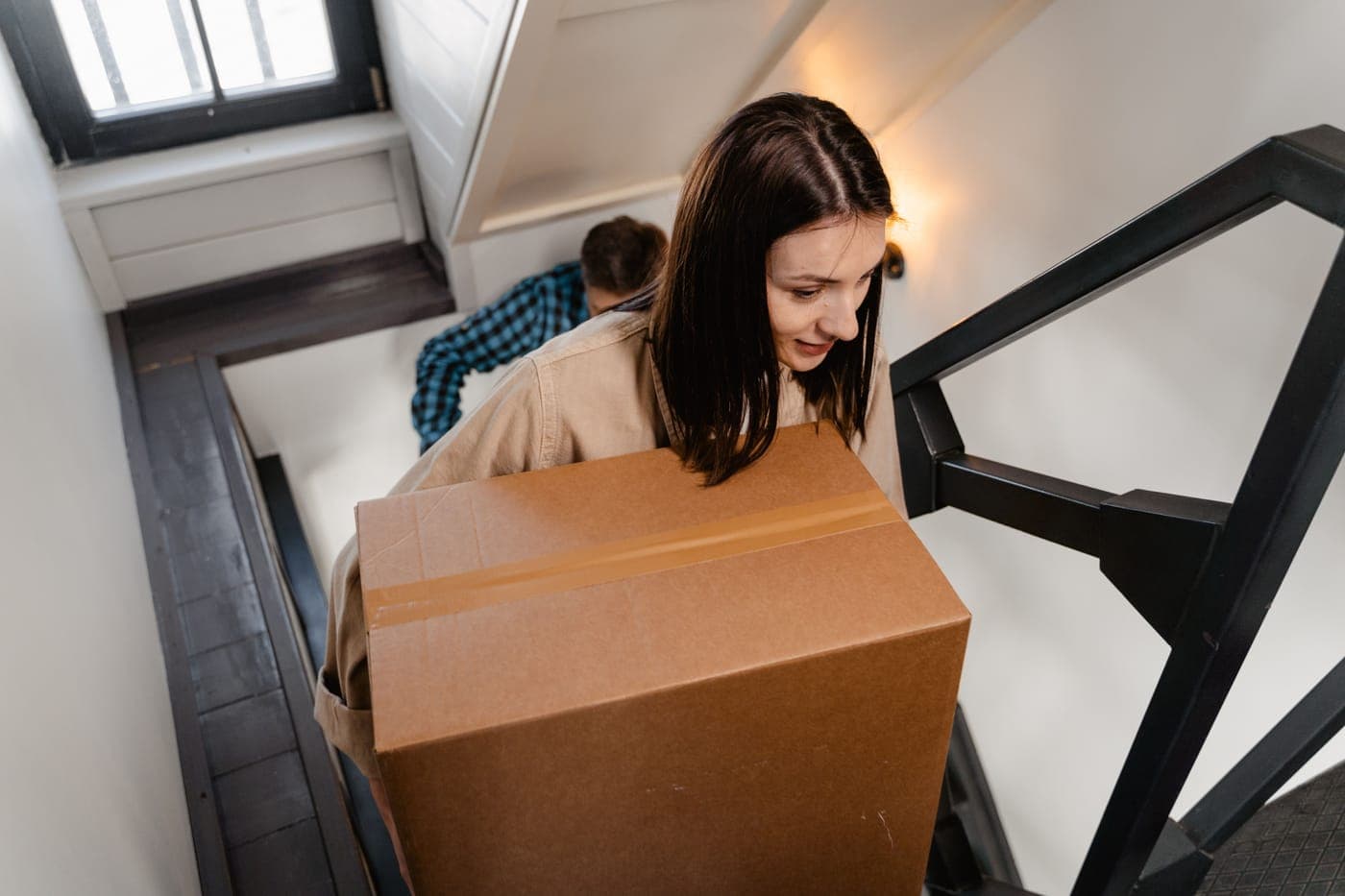
"Can a gun safe be transported lying down" is one of those questions where the internet is confident and the manufacturers are quiet. We looked at what the makers actually publish rather than what forums assert, and the pattern is consistent: every documented method keeps the safe upright on a dolly.
Everything below is from published manufacturer guidance and OSHA material, checked 2026-10-17. Each product cited carries a dated CPSC recall search on its card. If what you actually need is the whole moving procedure, read how to move a gun safe alongside this.
What the makers publish
Read that carefully: tipped back on a dolly, not laid out flat. That is the orientation the equipment, the straps and the whole procedure assume. The absence of any published flat-transport instruction is itself the answer most buyers are looking for.
What laying a safe down actually risks
Four specific things, in rough order of how often they cause trouble:
- The door and the lock take a load they were not designed for. A safe door is carried by its hinges and held by bolts along the edges. Upright, that weight runs down through the hinge line. On its back, the door's mass bears on the lock mechanism and the bolt work.
- The interior becomes a hazard. Shelves, racks and anything left inside move. Liberty's point about shifting contents is the reason to empty it, and it is more acute lying down.
- Getting it upright again is the dangerous part. Standing a 600 lb body back up in a confined space with people around it is harder than tipping it back onto a dolly ever was, and it is where feet and fingers get hurt.
- You cannot see what the walls did. A rated safe carries board insulation inside formed steel. Nothing you can inspect afterwards tells you whether a flat drop onto a truck bed stressed it, and no maker in our registry publishes a flat-transport rating that would cover it.
There is also a plain weight issue. OSHA's published interpretation on manual lifting is a useful reality check before anyone volunteers: the safes in our registry run from 115 lb to over 1,000 lb, and the ones people try to lay down are usually at the heavy end.
If it genuinely has to go flat
Sometimes a vehicle or a ceiling height leaves no option. In that case the sensible precautions, none of which make it a maker-endorsed procedure:
- Empty it completely, including shelves and door organisers, and remove the interior racks where they lift out.
- Lock it and secure the handle. A locked door spreads the load across the bolts rather than the latch, and it stops the door swinging as the safe rotates.
- Go onto its back, never onto the door. The back is a flat panel with nothing mounted on it. The door face carries the lock, the dial or keypad and the handle.
- Pad and strap it to the deck. Blankets underneath, straps over the body rather than through the handle, and no weight on top of it.
- Plan the stand-up before you lay it down. Who is doing it, on what surface, with what equipment, and with the dolly already in position.
- Test the lock before you reload it. Open and close it several times, check that the bolts throw fully, and only then put anything back in.
The upright method, in brief
- Measure the route first: the narrowest point, the turns, the ceiling height, the door swing.
- Empty the safe; keep the key or combination record with you, not in it.
- Appliance dolly rated for the weight, with straps and sturdy supports; a stair-climbing dolly for stairs.
- Tip back onto the dolly, strap the body, move slowly, and never let the safe lean away from you.
- On stairs, helpers lift the dolly one step at a time, after checking the staircase can take the load.
- Stand it in position, then anchor it before anything goes back inside.
Floor capacity is the other half of this and it is easy to skip in the moment. Run the check in can your floor support a gun safe before the safe goes anywhere above a slab, and read where to put a gun safe if the destination is still open.
Designs that avoid the problem entirely
Our picks for this
If moving is your constraint, buy for it
Three storage products that do not need to be tipped, laid down or carried whole, plus the anchoring kit you will need once it is in position.
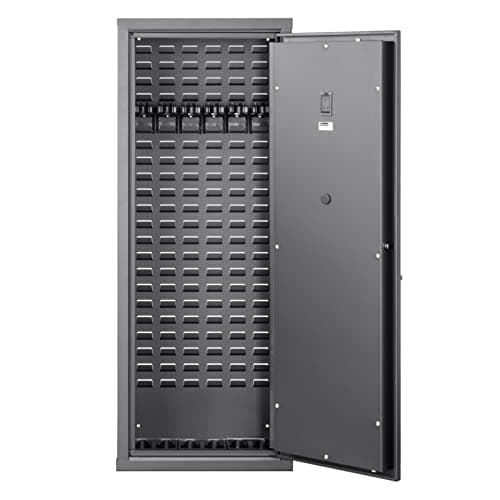
Best keypad long-gun cabinet for renters
SecureIt Agile Model 52
Access box5.5/10Assembles in place with a patented slide-lock design, 115 lb, six long guns up to 48.25 in. It goes up stairs flat-packed, which removes the problem rather than managing it.
$999.00Amazon#ad · Price as of October 19, 2026 · Disclosure for the link to SecureIt Agile Model 52
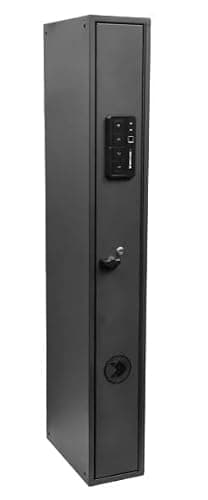
Best under-bed or closet long-gun box
SecureIt Fast Box Model 47
Access box6.7/1047 in of 14-gauge welded steel at 47 lb, designed to mount horizontally under a bed or vertically in a closet. Two people carry it in one trip.
$499.00Amazon#ad · Price as of October 19, 2026 · Disclosure for the link to SecureIt Fast Box Model 47
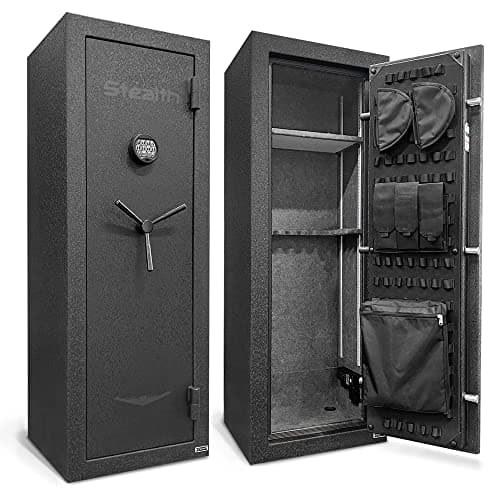
Best for apartments and first safes
Stealth EGS14
Access box5.0/10230 lb for a full-height 14-gun body, the lightest full-size safe we document. Upright on a dolly with three people is realistic here in a way it is not at 900 lb.
$1,099.99Amazon#ad · Price as of October 19, 2026 · Disclosure for the link to Stealth EGS14
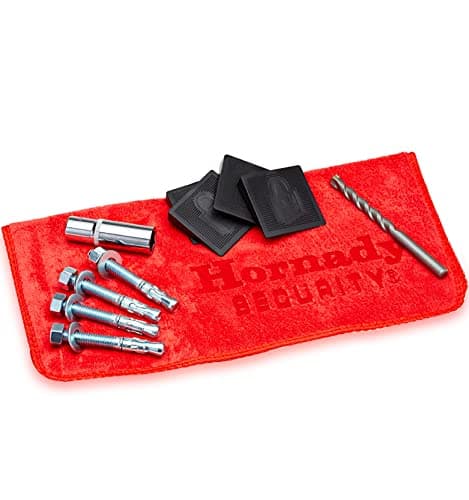
Best bolt-down kit for concrete floors
Hornady Premium Safe Anchoring Kit 95851
Accessory6.7/10Four 3/8 in concrete anchors with the carbide bit, socket and leveling shims. A hammer drill is required, and holes go at least 3 in deep.
$17.95Amazon#ad · Price as of October 19, 2026 · Disclosure for the link to Hornady Premium Safe Anchoring Kit 95851
That is the trade to understand before you buy on weight alone: the Agile 52 and Fast Box 47 state no burglary rating and no fire rating. They solve the logistics problem and they are access control, not a vault. Our gun safe vs gun cabinet page draws that line properly.
After the move
- Anchor it the same day. A safe that arrives and sits unbolted usually stays unbolted. The Hornady anchoring kit is the straightforward route on a concrete floor; our bolt-down guide covers wood framing and the fire-rating caveats.
- Cycle the lock ten times before reloading. Electronic or mechanical, you want to know now rather than later.
- Check the door gap along its whole length. An even gap top to bottom means nothing has racked.
- Re-level it. A safe on an out-of-level floor binds its own bolts; shims come with most anchoring kits for exactly this.
- Replace the batteries while the door is open. Cheap insurance, and it resets the clock you will forget about. See how to open a gun safe with a dead battery.
How we scored this
Every pick, checked against the paperwork
Here is exactly what goes into a score: whether an independent lab listed the safe (UL for burglary under UL 1037, UL or Intertek for fire), the maker's published steel, lock and bolt-down specs, the owner's manual, a dated CPSC recall search, and a public rubric applied the same way to every safe. Every figure links to where it came from, so you can confirm the pick in a couple of clicks and buy with confidence.
Scores are our editorial judgment of that documented evidence. Commissions never set a score or decide a pick. The rubric and its weights are published.
Questions
Frequently asked
Can a gun safe be transported lying down?
Can you lay a gun safe on its back?
Does laying a safe down damage the fire insulation?
How many people does it take to move a gun safe?
Should I empty the safe before moving it?
Keep reading
Related on Bolt & Vault
- How to move a gun safeThe full procedure, equipment list and when to hire movers.
- Can your floor support a gun safe?Run this before the safe goes anywhere above a slab.
- How to bolt down a gun safeAnchoring into concrete or framing once it is in position.
- Best gun safes for apartmentsWhere weight and access routes decide the shortlist.
- Best gun safes for a storage unitIf the move is into rented space, the rules change again.
Receipts
Sources
- Liberty Safe — tips for moving a gun safe on your own: emptying the safe, dolly supports, tipping back (checked 2026-10-17)
- Liberty Safe — how to get a safe upstairs: helpers lifting the dolly one step at a time, staircase capacity (checked 2026-10-17)
- Liberty Safe — why you should have a professional mover install your safe (checked 2026-10-17)
- OSHA — standard interpretation on manual lifting and weight limits
- SecureIt — Agile Model 52: in-place assembly, weight, no burglary or fire rating stated (checked 2026-10-17)
- SecureIt — Fast Box Model 47: 14-gauge welded steel, mounting orientation, weight (checked 2026-10-17)
- Hornady — Premium Safe Anchoring Kit 95851: contents and installation requirements (checked 2026-10-17)
- CPSC — recall database searched per brand on this page
Every figure above is traceable. Ratings come from the listing body or the maker's own spec pages (linked on every product), recall status from dated CPSC searches, and law summaries from official sources. Prices come live from Amazon so the number you see is the number you pay. Read the full method.