Setup & Safe Storage · Guide
Gun safe humidity levels: the range to aim for and how to hold it
Rust needs moisture, and a closed steel box can trap it. Here is the target range, where it comes from, and how to measure and hold it inside your safe.
By Mike M.Updated Researched, not lab-tested
#adReader-supported: we may earn a commission if you buy through our links, at no extra cost to you. It never decides a ranking. How we rate · Disclosure
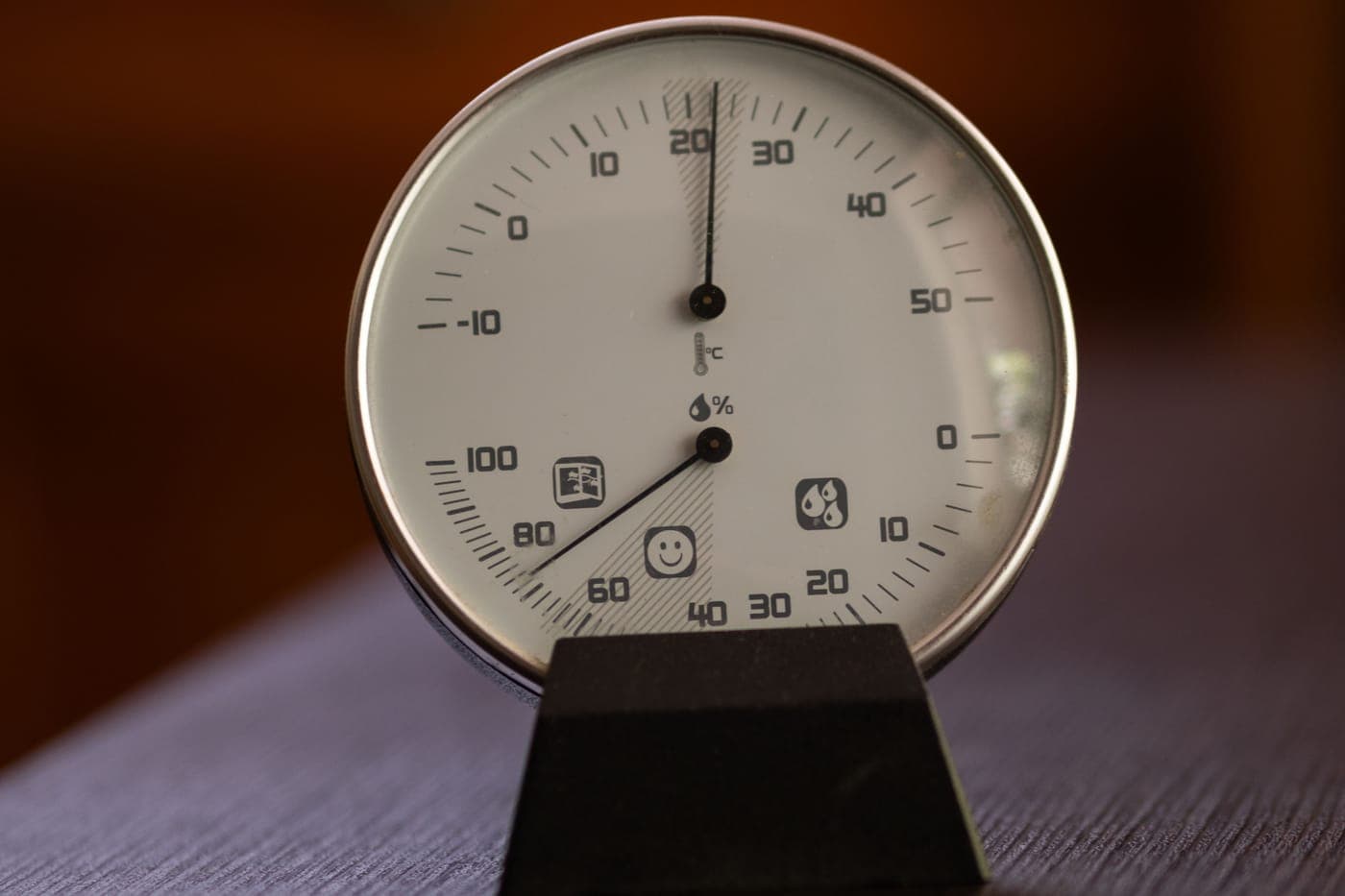
A gun safe is built to keep people out, not air. Every time the door opens, room air comes in with whatever moisture it carries, and a closed steel box can hold that moisture against metal and wood for weeks. The fix is not complicated: know the target, measure it where it matters (inside the safe), and add moisture control only if the readings say you need it. This guide sets out the number and the sources behind it.
The target: 30 to 50 percent, held steady
The target doesn't come from a safe rating. It comes from preservation and household guidance. Three sources point the same way:
- Liberty Safe, citing the NRA. Liberty's article on humidity and firearms says the NRA recommends keeping the humidity in a vault room or gun safe between 30 and 50 percent, with the temperature at 70°F or below. Liberty adds that it errs toward about 30 percent, but not much drier.
- The EPA, for indoor air in general. The EPA's guide to mold and moisture says to keep indoor humidity below 60 percent, ideally between 30 and 50 percent. Since the safe breathes room air, a room in that band gives the safe a head start.
- The National Park Service, for museum firearms. The NPS Conserve O Gram on caring for historic longarms doesn't give a single number. Its instruction is to maintain constant relative humidity, because firearms combine wood, metal and sometimes plastic, and each reacts differently to changes.
Put together: land somewhere in the 30s or 40s and keep it there. Stability is part of the target, not an extra. Here is how we read a hygrometer inside a safe:
| Reading inside the safe | What it means | What to do |
|---|---|---|
| Below 30% | Drier than the NRA-attributed range; Liberty warns wood stocks stored too dry can shrink, crack or chip | Ease off: recharge desiccants less often, or check whether a rod is overkill for the room |
| 30% to 50% | Inside the range Liberty attributes to the NRA and the EPA's ideal indoor band | Keep checking; watch the high/low memory for spikes |
| 50% to 60% | Above the gun-safe range, still under the EPA's 60% ceiling for indoor air | Add or upgrade moisture control; check placement |
| Above 60% | Above the EPA's limit for indoor air, never mind a gun safe | Act now: dehumidify the safe and look at the room or the location |
Why humidity inside a safe matters
Liberty's humidity article describes rust as iron reacting with oxygen in the presence of water or humid air, and notes that once rust starts there is very little you can do to stop it short of conservation work. Its second article, on managing temperature and humidity inside a safe, makes two further points worth knowing:
- A safe isn't airtight. Each time the door opens, room air enters. If that air is humid, the moisture comes in with it.
- Temperature swings create condensation. When warm, moist air meets cooler steel and cools to its dew point, water forms on the surface. Liberty compares it to the sweat on a cold drink.
Too dry is a problem in the other direction. Liberty notes that wood stocks hold some water and can shrink, crack or chip if stored too hot or too dry, which is why the range has a floor as well as a ceiling. Documents and other valuables in the safe benefit too: Liberty points out that the Library of Congress recommends a relatively dry but not too dry environment for books and paper.
What "relative" humidity means for a safe
A hygrometer reports relative humidity: how much moisture the air holds compared with the most it could hold at its current temperature. The word "relative" is the key to why temperature swings matter. When the same air cools, its relative humidity rises, and if it cools to its dew point the excess moisture condenses onto whatever is coolest. Inside a safe, that is usually the steel walls and the guns.
That has three practical consequences:
- Read humidity and temperature together. A reading that climbs overnight while the temperature drops is the pattern that leads to condensation. Monitors that show both, with highs and lows, make it visible.
- Steadiness beats a perfect number. This is why the NPS stresses constant humidity and why Liberty talks about a stable, cool environment rather than a single target.
- Warming rods work on the same physics. By keeping the air and metal inside the safe slightly warmer than the room, a rod keeps surfaces above the point where moisture condenses, which is how Liberty explains the way they work.
Where to put the hygrometer
A hygrometer in the room tells you about the room. The reading that matters is inside the closed safe, where humidity can drift away from the room's. Practical placement:
- Inside the safe, mid-height, on a shelf or door panel. Keep it clear of a dehumidifier rod so it reads the safe's air rather than the warm air right at the heater. Lockdown tells owners to mount its rod horizontally at the lowest point in the safe, so a shelf above it is a sensible spot for the monitor.
- Read it daily for the first week. Liberty's environmental-control guide suggests checking daily at first to learn the pattern: does humidity spike after you open the door, or climb overnight?
- Use the high/low memory. A monitor that records highs and lows shows what happened while the door was shut, which is the part you can't see.
- Then settle into a routine. Liberty's humidity article suggests weekly checks at first, moving to a bimonthly or monthly routine once several checks look fine.
Remote-sensor hygrometers let you read the safe without opening it, which also avoids letting room air in. One caution from the spec sheets: Hornady's wireless hygrometer page doesn't say whether the sensor's signal reaches the base through a closed steel safe, so check that claim with the maker before relying on it.
Garages and basements
Where the safe sits decides most of the humidity battle. Liberty's humidity article calls a non-climate-controlled garage, where temperatures can exceed 100°F in summer and drop below freezing in winter, not an ideal place to store firearms, and it puts a musty basement with water condensing on the walls and floor in the same category. Radical temperature changes, it notes, can cause condensation, and condensation leads to rust, mold and corrosion.
Liberty's environmental-control guide adds three placement details that apply to any room:
- Avoid an exterior wall that runs cooler than the rest of the room.
- Avoid direct blasts from heating and cooling vents, which cause quick swings.
- On concrete, which can contribute to moisture, keep airflow moving and monitor seasonal changes.
If you're still choosing a spot, our guide to where to put a gun safe weighs humidity against fire, access, concealment and floor load.
How the seasons move the number
The same safe can read very differently in July and January, because the room air it breathes changes. That is why a single reading in the week you set things up isn't enough, and why the high/low memory is worth having. A few habits keep seasonal drift in check:
- Recheck at each change of season. A desiccant that lasted weeks between recharges in a dry month may saturate faster in a humid one, and a plug-in rod that kept the safe in range in one season may need help in another.
- Watch for the floor as well as the ceiling. If winter readings sink below 30 percent, ease off rather than keep drying. Liberty's warning about wood stocks applies.
- Look at the room when the safe can't keep up. The EPA's advice for lowering indoor humidity, such as venting moisture-producing appliances outdoors, helps the safe as well as the house.
How to bring humidity down
Do gun safes need a dehumidifier? Not always. Liberty's humidity article suggests one when your home's indoor air runs above about 40 percent and whole-home climate control isn't an option. The hygrometer will tell you. If it does need help, there are three main types, and our electric vs rechargeable dehumidifier comparison goes deeper:
| Type | How it works | Fits best | Watch for |
|---|---|---|---|
| Plug-in warming rod | Gently warms and circulates the air; Liberty says the difference is only about 3 degrees, enough to keep metal from condensing moisture | A safe with power inside or a pass-through for a cord | Needs an outlet; confirms nothing on its own, so pair it with a hygrometer |
| Rechargeable desiccant | Silica gel absorbs moisture; you take it out and plug it in to dry it | A safe with no power | A recharge routine; Liberty notes it shouldn't be left plugged in all the time |
| Silica gel canister | No power; reactivated in an oven when the indicator changes color | Small safes and cabinets | Lower rated coverage and oven time |
On sizing: makers rate these units by the enclosed volume they cover, and gun safe interiors tend to sit well inside those ratings. Hollon, for example, lists 16.93 cubic feet for its Republic RG-22, while Lockdown rates its 18-inch Golden Rod for up to 200 cubic feet and Eva-Dry rates its E-333 for up to 333 cubic feet. So the choice usually comes down to power and routine rather than size. Our best gun safe dehumidifiers roundup ranks the full field by that fit.
Our picks for this
Measure first, then control
A hygrometer to tell you whether the safe needs help, and one dehumidifier for each power situation. None of these carries a UL or ETL listing on the maker's page, which we note on each card.
 Stock photo
Best in-safe hygrometer
Liberty Safe Humidity and Temperature Monitor
Accessory7.3/10Start here: it records highs and lows inside the closed safe, so you know whether you need a dehumidifier at all. Accuracy isn't published.
Check price · Amazon#ad · Price set by Amazon · Disclosure for the link to Liberty Safe Humidity and Temperature Monitor
 Stock photo
Best for a gun safe with power
Lockdown Golden Rod Dehumidifier Rod (18 in.)
Accessory7.0/10For a safe with power inside: rated for up to 200 cu ft at 18 in., runs continuously, limited lifetime warranty.
Check price · Amazon#ad · Price set by Amazon · Disclosure for the link to Lockdown Golden Rod Dehumidifier Rod (18 in.)
- Stock photo
Best cordless pick for a safe without power
Eva-Dry E-333 Renewable Mini Dehumidifier
Accessory6.9/10For a safe with no outlet: cordless silica gel rated for 333 cu ft, with a color indicator and a 10-12 hour recharge.
Check price · Amazon#ad · Price set by Amazon · Disclosure for the link to Eva-Dry E-333 Renewable Mini Dehumidifier
A first-month plan
- Week one: measure only. Put the hygrometer in the closed safe and read it daily, noting the high and low and whether humidity jumps after the door has been open.
- Decide. If the safe holds 30 to 50 percent with no big swings, you may not need a dehumidifier at all. If it runs high or swings widely, choose a rod (power available) or a rechargeable unit (no power).
- Weeks two to four: confirm. Keep reading the monitor after the dehumidifier goes in. The goal is a steady number inside the range, not the lowest number possible.
- After that: routine checks. Move to Liberty's suggested weekly-then-monthly rhythm, recheck at each change of season, and inspect the guns themselves while you're there.
Storage habits that trap moisture
The right number on the hygrometer can still be undone by what goes into the safe:
- Padded and foam-lined cases. Both Liberty articles advise against long-term storage in padded or foam-lined cases, which can hold moisture against the gun's surface.
- Leather slings and scabbards. The NPS guidance says to avoid storing firearms with leather slings or in leather scabbards, because leather can react with the metal. Store those accessories separately.
- Damp gear. Liberty's environmental guide says not to put damp cleaning rags or recently used gear in the safe, and to let items air out first if they've been somewhere wet.
- Bare-hand handling. Liberty notes that skin acids and moisture can start rust, and suggests wiping down anything you've handled with a protective product before it goes back in.
- Storing ammunition in the same box. The NPS guidance lists storing guns and ammunition separately among its storage rules, and it is standard safe-storage advice in homes with children too.
Humidity control is one part of a setup that also includes anchoring. If the safe isn't bolted down yet, our guide to bolting down a gun safe covers each floor type.
How we scored this
Safes we claim to have lab-tested: 0
Plenty of sites say they drilled, burned and flooded every safe they list. We didn't, and we say so. What we do instead: check whether an independent lab listed the safe (UL for burglary under UL 1037, UL or Intertek for fire), read the maker's published steel, lock and bolt-down specs, search CPSC recalls, and score every pick on a public rubric. Every figure links to where it came from.
Scores are editorial judgments from that documented research, not lab results. Commissions never set a score or decide a pick. The rubric and its weights are published.
Questions
Frequently asked
What is the proper humidity for a gun safe?
Do gun safes need a dehumidifier?
Do gun safes rust inside?
Can a gun safe be too dry?
Where should a hygrometer go in a gun safe?
Is a garage too humid for a gun safe?
Keep reading
Related on Bolt & Vault
- Best gun safe dehumidifiersRods, rechargeables and canisters ranked by fit.
- Electric vs rechargeable dehumidifiersWhich moisture control suits your safe's power and your routine.
- Where to put a gun safeLocation decides most of the humidity battle.
- Best long-gun safesBig safes with room for rifles, and for a dehumidifier.
Receipts
Sources
- Liberty Safe — The Impact of Humidity on Firearms (cites the NRA's 30-50% RH recommendation; checked 2026-09-19)
- Liberty Safe — Safe Environmental Control: Managing Temperature and Humidity Inside Your Safe (checked 2026-09-19)
- U.S. EPA — A Brief Guide to Mold, Moisture and Your Home (checked 2026-09-19)
- National Park Service — Conserve O Gram 10/1, Caring for Historic Longarms: Storage and Handling Requirements (PDF, checked 2026-09-19)
We don't lab-test safes and we don't pretend to. Ratings come from the listing body or the maker's own spec pages (linked on every product), recall status from CPSC searches, and law summaries from official sources. Prices are set by Amazon and change often, so we don't print them. Where a figure isn't published, we say so. Read the full method.