Safe Ratings Explained · Head to head
Electronic vs mechanical safe locks: which belongs on your gun safe?
Dials and keypads compared on what decides daily life with a safe: speed, batteries, lockouts, code changes and service, plus what the UL lock ratings actually cover.
By Mike M.Updated Researched, not lab-tested
#adReader-supported: we may earn a commission if you buy through our links, at no extra cost to you. It never decides a ranking. How we rate · Disclosure
The contenders
Side by side
 Stock photo
Mechanical dial: gun safe
American Security BFX6030
UL RSC9.1 /10A UL-rated mechanical dial as standard on a UL RSC Level 1 safe, with an electronic lock offered. No batteries to fail, but slower to open. Dealer-sold.
See it at American Security (maker's site)Sold through dealers, not Amazon. Plain link: we don't earn a commission there.
- Stock photo
Electronic keypad: gun safe
American Security NF6036
UL RSC8.5 /10The same maker and RSC Level 1 listing with a UL-rated AMSEC electronic keypad (ESL10 per the retailer; AMSEC's 2025 page listed an ESL5). Sold on Amazon.
Check price · Amazon#ad · Price set by Amazon · Disclosure for the link to American Security NF6036
 Stock photo
Mechanical Simplex: pistol box
Fort Knox Original Pistol Box
Access box8.8 /10A push-button Simplex lock with no batteries and over 1,000 possible combinations, on a 10-gauge body. Built to be bolted down.
Check price · Amazon#ad · Price set by Amazon · Disclosure for the link to Fort Knox Original Pistol Box
- Stock photo
Electronic keypad: pistol box
GunVault MicroVault MV500
Access box7.2 /10A No-Eyes keypad with a 3- to 6-digit code, alkaline batteries and a high-security backup key. GunVault suggests new batteries at least every 6 months.
Check price · Amazon#ad · Price set by Amazon · Disclosure for the link to GunVault MicroVault MV500
- Stock photo
Dial standard, keypad optional
Liberty Presidential 25
UL RSC8.2 /10A UL-listed S&G mechanical lock as standard, with Dormakaba or S&G Spartan electronic locks available at order. Sold on Amazon.
Check price · Amazon#ad · Price set by Amazon · Disclosure for the link to Liberty Presidential 25
- Stock photo
Keypad standard, dial optional
Stealth UL28
UL RSC7.5 /10A UL-listed electronic lock with external battery access and no override key listed. Stealth offers a mechanical dial as an upgrade.
Check price · Amazon#ad · Price set by Amazon · Disclosure for the link to Stealth UL28
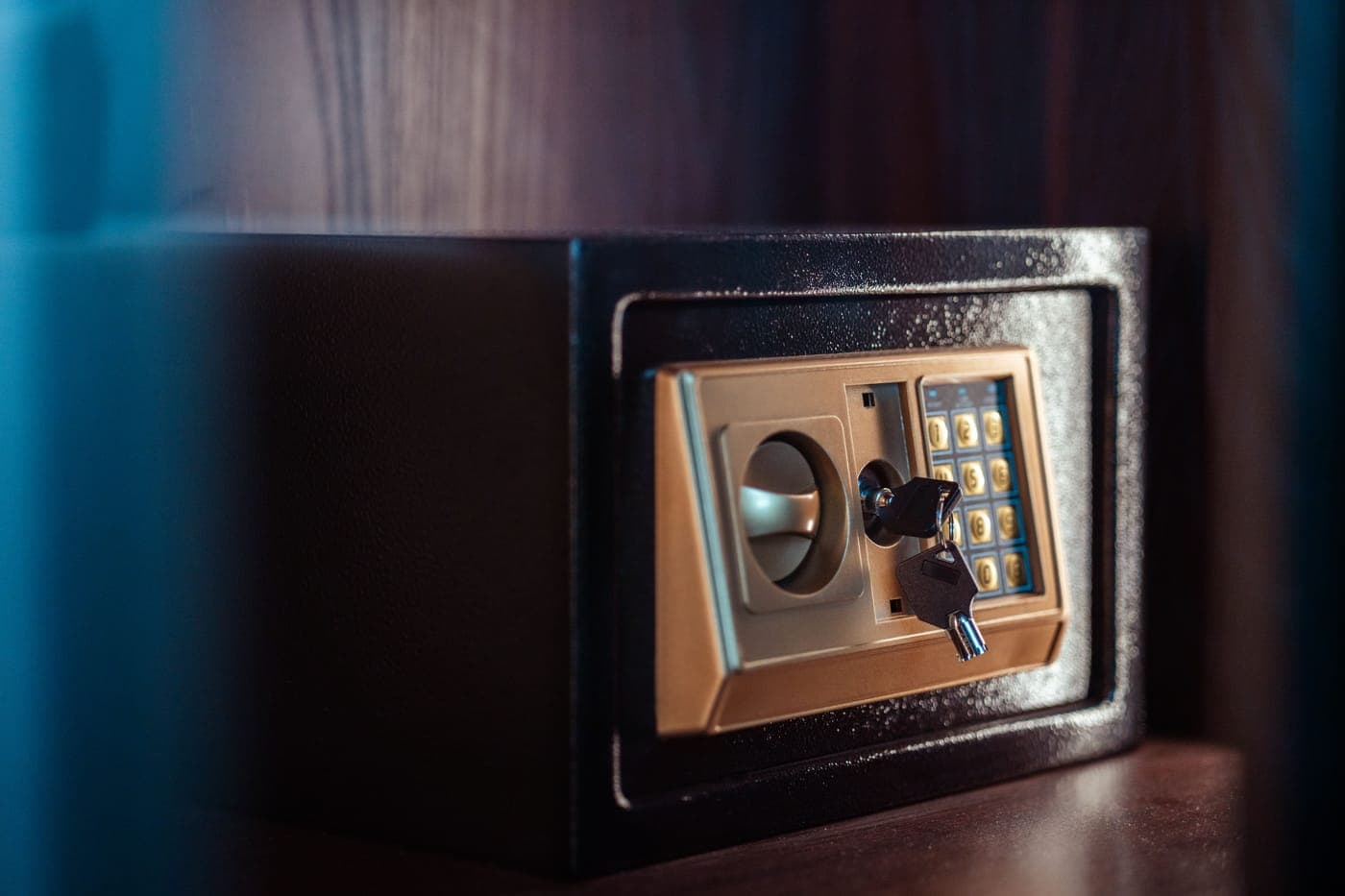
The differences at a glance
Two safe dealers publish side-by-side lock comparisons, Safe and Vault Store (mechanical vs electronic vs biometric) and Dean Safe (lock logic). Where they give figures, we quote them and say whose they are. Lock makers' own documents fill in the rest.
| Question | Mechanical dial | Electronic keypad |
|---|---|---|
| How fast does it open? | "20-60 seconds" (Safe and Vault Store); overshoot a number and you start the sequence again (Dean Safe) | "5-10 seconds" (Safe and Vault Store); "under three seconds" (Dean Safe) |
| Does it need power? | No | Yes: "typically 9V or AA" batteries, changed from outside the safe (Safe and Vault Store) |
| What happens after wrong entries? | You dial the sequence again | A penalty lockout, "5 to 15 minutes" in Dean Safe's experience; 2 minutes after three wrong entries on the SentrySafe SFW123GDC, per its manual |
| Who changes the code? | Key-changeable at the lock, per Sargent & Greenleaf; both dealers say to use a technician | "You can change your combination yourself at any time" (Safe and Vault Store) |
| Servicing | "Every 3 to 5 years by a qualified safe technician" (Safe and Vault Store) | S&G says its electronic locks are "not designed to be user serviceable" |
| How long does it last? | "Can easily outlive the person who bought it" (Dean Safe) | Typically "10 to 15 years" (Dean Safe) |
| Which UL standard? | UL 768, combination locks | UL 2058, high-security electronic locks |
The pattern is consistent across sources: the dial trades speed for independence from batteries and a very long service life, while the keypad trades a battery and a finite lifespan for speed and convenience.
Lock ratings: UL 768 groups and electronic Type 1
Mechanical combination locks are rated under UL 768, which UL says tests "the ability of combination locks to resist unauthorized opening of the combination locks by sense of sight, touch, or hearing." The same scope is explicit that "these requirements do not cover electronic locks" (UL 768). Safe and Vault Store summarizes the groups this way:
- Group 2: "The standard rating found on most consumer safes. Based on minimum construction standards and dialing tolerances only."
- Group 2M: "Adds 2 man-hours of expert manipulation resistance on top of the Group 2 baseline."
- Group 1: "Rated to resist 20 man-hours of expert manipulation."
- Group 1R: "All the features of Group 1 plus an additional 20 hours of resistance to radiological attacks."
A common example: Sargent & Greenleaf's 6730 dial lock lists UL Group 2 certification, a "key changeable wheel design for simple combination changing" and a "familiar left-right-left dialing sequence" ( S&G 6730 spec sheet). Makers of the gun safes on this page say "UL-listed" or "UL-rated" dial without naming the group, so ask if the group matters to you.
Electronic safe locks have their own UL standard, UL 2058, titled "High-Security Electronic Locks" (UL 2058). Safe and Vault Store calls a UL Type 1 electronic lock "the high-security designation for digital locks" and adds that "UL will not certify a Type 1 lock with a key override". Consistent with that, the Stealth UL28 pairs a UL-listed electronic lock with external battery access and lists no override key.
One rule covers both types: a listed lock is not a listed safe. Liberty's Centurion uses a UL-listed electronic lock, but Liberty cites no UL listing for the safe body. The burglary listing that matters for the whole safe is the one our UL RSC rating explainer covers.
Reliability, and what to do when a keypad goes dead
A dial has no electronics to fail, which is why dealers credit it with such a long life, though Safe and Vault Store still recommends periodic servicing. An electronic lock's weak points are its power and its keypad. Sargent & Greenleaf's troubleshooting guide for its older 6120 and 6123 keypad locks lists the usual causes when a lock won't open: a wrong code, the # key not pressed, batteries that need replacing, the lock sitting in security lockout, a defective keypad or a broken wire (S&G troubleshooting guide). The same guide calls for fresh nine-volt alkaline batteries and warns that "Extra Heavy Duty" batteries are not alkaline and will not work.
Batteries are a schedule, not an emergency. GunVault suggests changing the MV500's batteries at least every six months, and Dean Safe recommends a "brand new, name brand 9 Volt Alkaline battery with an expiration date at least 4 years in the future" for 9V locks. Liberty notes that on its S&G locks the batteries sit in the keypad outside the safe, so they can be replaced with the door locked (Liberty).
Speed, codes and children
For a bedside pistol box, speed and simplicity dominate, and both lock types show up. The Fort Knox Original Pistol Box uses a Simplex mechanical push-button lock with "over 1,000 possible combinations" and no batteries; V-Line's Desk Mate lists 1,081. The GunVault MV500 uses a keypad with a 3- to 6-digit code and a backup key. For comparison, S&G lists "1 million possible combinations" for its 3-wheel 6630 dial (S&G 6600 series).
With children in the house, the lock type matters less than the habits around it. Keep codes and keys out of reach, choose a code no one in the house could guess, and change it if you think it has been seen. Electronic locks make that last step easy; a dial usually means a service call. For bedside boxes that add fingerprint or RFID entry, see biometric vs keypad vs RFID gun safes and are biometric gun safes reliable?
The safes side by side
Four gun safes, two with each lock type as standard. Every cell links to its source; a dash means the figure isn't published in the sources we checked.
And the two pistol boxes, one mechanical and one electronic:
The gun safes and the pistol boxes are scored on different published rubrics, so compare scores within each table, not across them. On the gun-safe rubric, lock and entry is 15% of the score, below the independent burglary listing (30%) and construction and fire evidence (20% each); the lock is rarely the reason to choose one safe over another, but it is the part you touch every day.
Which lock for which owner
- Long-term storage opened rarely, no appetite for batteries: a mechanical dial. Plan on the periodic service dealers recommend.
- Opened often, or by more than one adult: an electronic keypad, with a battery change on your calendar and the backup entry checked before you need it.
- Can't decide: buy a safe that offers both at order. The Liberty Lincoln 25 offers three lock choices, the Stealth UL28 a dial upgrade, the AMSEC BFX6030 an electronic option, and the AMSEC RF6528 five choices.
- A bedside pistol box: a Simplex lock if you never want a dead battery, a keypad with a backup key if you want more possible codes. Our no-battery pistol safe picks cover the mechanical side.
Whatever the lock, it sits on a safe, and the safe's own listing does most of the protecting. If you are still choosing the safe itself, start with how to choose a gun safe.
In detail
The contenders, in full
Stock photoMechanical dial: gun safe
American Security BFX6030
A UL-rated mechanical dial as standard on a UL RSC Level 1 safe, with an electronic lock offered. No batteries to fail, but slower to open. Dealer-sold.
EvidenceResearched · not lab-tested
| Tier | UL RSC. A timed hand-tool attack under UL 1037 (Level 1: one person, five minutes, common hand tools). |
|---|---|
| Burglary rating | UL RSC Level 1 security rating |
| Fire rating | ETL fire rating: 120 min at 1,200°F (ETL-verified) |
| Body steel | 11 gauge outer and 12 gauge inner steel liner, with concrete insulation between the walls |
| Door steel | 1/2-in steel plate door |
| Lock | UL-rated mechanical dial lock (electronic lock option) |
| Bolt-down | 4 pre-cut anchor holes |
| Capacity | 22 guns in the safe plus 2 on the door (maker-stated) |
| Exterior dimensions | 59.25 x 30 x 26 in (H x W x D) |
| Weight | 1,081 lb |
| Warranty | 5-year parts and labor with a factory-installed AMSEC lock; lifetime warranty for damage from burglary attempts and fire |
| Recall check | Sep 19, 2026: No CPSC recall found for American Security (AMSEC) gun safes in a search of CPSC.gov recall notices. |
How the 9.1 score breaks down
- Independent burglary certification (30%)
- 9
- Construction (20%)
- 9.5
- Fire protection evidence (20%)
- 9.5
- Lock & entry (15%)
- 9
- Fit & usability (10%)
- 8
- Support & transparency (5%)
- 9
What the evidence supports
- Both evidence fields come from outside labs: UL RSC Level 1 for burglary and an ETL fire rating of 120 minutes at 1,200°F.
- 1/2-in steel plate door, 14 locking bolts 1 1/2 in thick, and a double steel wall (11-gauge outer, 12-gauge inner), per the retailer spec sheet.
- UL-rated mechanical dial as standard, with an electronic lock available.
- Made in the USA, per AMSEC.
Where it falls short
- Not sold on Amazon: buy through an AMSEC dealer.
- 1,081 lb in a 30-in-wide footprint: plan delivery and floor load.
- The 5-year parts-and-labor coverage applies only with a factory-installed AMSEC lock.
Skip this if…
…you need to buy on Amazon or keep the safe under 1,000 lb: this is a dealer-sold, 1,081-lb safe.
Sold through dealers, not Amazon. Plain link: we don't earn a commission there.
Stock photoElectronic keypad: gun safe
American Security NF6036
The same maker and RSC Level 1 listing with a UL-rated AMSEC electronic keypad (ESL10 per the retailer; AMSEC's 2025 page listed an ESL5). Sold on Amazon.
EvidenceResearched · not lab-tested
| Tier | UL RSC. A timed hand-tool attack under UL 1037 (Level 1: one person, five minutes, common hand tools). |
|---|---|
| Burglary rating | UL RSC Level 1 |
| Fire rating | ETL-verified: 90 min at 1,200°F |
| Body steel | 11 gauge |
| Door steel | 1/4-in steel plate door |
| Lock | UL-rated AMSEC ESL10 electronic lock (retailer listing) |
| Bolt-down | 4 pre-cut anchor holes |
| Capacity | 34 guns plus 2 on the door (retailer listing) |
| Exterior dimensions | 59 x 36 x 26 in (H x W x D) |
| Weight | 977 lb |
| Warranty | Lifetime warranty against burglary and fire (retailer listing) |
| Recall check | Sep 19, 2026: No CPSC recall found for American Security (AMSEC) gun safes in a search of CPSC.gov recall notices. |
How the 8.5 score breaks down
- Independent burglary certification (30%)
- 8.5
- Construction (20%)
- 8.5
- Fire protection evidence (20%)
- 9
- Lock & entry (15%)
- 8
- Fit & usability (10%)
- 8
- Support & transparency (5%)
- 8
What the evidence supports
- Independent evidence on both fronts: UL RSC Level I for burglary and a 90-minute ETL-verified fire rating.
- 11-gauge body, 1/4-in plate door and 14 locking bolts 1 1/2 in thick, per the retailer spec sheet.
- Interior LED light kit, electrical outlet and door organizer included, per the retailer listing.
- Sold on Amazon.
Where it falls short
- Lock model differs by source: the retailer lists a UL-rated ESL10, while AMSEC's 2025 product page listed an ESL5. Confirm at purchase.
- 977 lb and 36 in wide: check doorways and floor load.
- Lock and parts warranty terms are not published on the listing we checked; only the lifetime burglary and fire coverage is.
Skip this if…
…you want a mechanical dial as standard: this model ships with an electronic keypad lock.
#ad · Price set by Amazon · Disclosure for the link to American Security NF6036
Stock photoMechanical Simplex: pistol box
Fort Knox Original Pistol Box
A push-button Simplex lock with no batteries and over 1,000 possible combinations, on a 10-gauge body. Built to be bolted down.
EvidenceResearched · not lab-tested
| Tier | Access box. Children and unauthorized hands. Not a determined burglar with tools. |
|---|---|
| Burglary rating | Not stated by the maker (no UL RSC listing cited) |
| Fire rating | Not stated by the maker |
| Body steel | 10-gauge steel body |
| Door steel | 3/16 in plate wrap-around door; concealed continuous hinge; reinforced lock plate |
| Lock | Simplex mechanical push-button lock, over 1,000 possible combinations; no batteries |
| Backup entry | Not applicable: fully mechanical lock with no electronics (no key override listed) |
| Bolt-down | Four pre-drilled 3/8 in anchor holes |
| CA DOJ | Listed on the CA DOJ roster as 'Fort Knox Pistol Box - FKPB' (usable interior up to 11 x 9 x 3 in) |
| Exterior dimensions | 10.25 x 12.5 x 4.35 in (D x W x H) |
| Weight | 22 lb |
| Warranty | Limited lifetime warranty; made in the USA |
| Recall check | Sep 19, 2026: No CPSC recall found for Fort Knox pistol boxes in a search of CPSC.gov recall notices. |
How the 8.8 score breaks down
- Access reliability evidence (30%)
- 9.5
- Construction & pry resistance (25%)
- 9.5
- Child-access standards (20%)
- 8.5
- Mounting (15%)
- 7
- Support & transparency (10%)
- 8
What the evidence supports
- Simplex mechanical lock needs no batteries and can be worked by feel in the dark, per Fort Knox
- Heavy published steel for a pistol box: 10-gauge body and 3/16-inch door
- Concealed continuous hinge and reinforced lock plate for pry resistance, per the maker
- Limited lifetime warranty; made in the USA
Where it falls short
- About 1,000 combinations is far fewer than a 6-digit keypad allows
- No security cable: it is meant to be bolted down
- No UL burglary listing, and at 22 lb it is heavy to move
Skip this if…
…you need a portable box for travel or a car; it is built to be bolted down and weighs 22 lb.
#ad · Price set by Amazon · Disclosure for the link to Fort Knox Original Pistol Box
Stock photoElectronic keypad: pistol box
GunVault MicroVault MV500
A No-Eyes keypad with a 3- to 6-digit code, alkaline batteries and a high-security backup key. GunVault suggests new batteries at least every 6 months.
EvidenceResearched · not lab-tested
| Tier | Access box. Children and unauthorized hands. Not a determined burglar with tools. |
|---|---|
| Burglary rating | Not stated by the maker (no UL RSC listing cited) |
| Fire rating | Not stated by the maker |
| Body steel | 16-gauge steel |
| Lock | No-Eyes keypad, programmable 3- to 6-digit code |
| Backup entry | High-security manual key |
| Bolt-down | Pre-drilled mounting holes |
| CA DOJ | Listed on the CA DOJ roster as 'MV 500' (firearms up to 10.5 in long, 6 in wide, 2 in high) |
| Power | Alkaline batteries; the low-battery light flashes while you enter your code, and GunVault suggests changing batteries at least every 6 months |
| Warranty | 1 year on workmanship and materials; 5 years for damage from fire, burglary or attempted burglary |
| Recall check | Sep 19, 2026: No CPSC recall found for GunVault safes in a search of CPSC.gov recall notices. |
How the 7.2 score breaks down
- Access reliability evidence (30%)
- 7.5
- Construction & pry resistance (25%)
- 6.5
- Child-access standards (20%)
- 8.5
- Mounting (15%)
- 6.5
- Support & transparency (10%)
- 6
What the evidence supports
- No-Eyes keypad is designed for entry by touch in low or no light, per GunVault
- Anti-pry tabs, a reinforced U-lock and concealed hinges, per GunVault
- Listed on California's roster
- Five-year coverage for burglary or attempted-burglary damage
Where it falls short
- GunVault's product page lists no dimensions, weight or battery type
- Keypad codes are only 3 to 6 digits
- No UL burglary listing
Skip this if…
…your handgun is longer than 10.5 inches; that's the fit the CA DOJ roster lists for this box.
#ad · Price set by Amazon · Disclosure for the link to GunVault MicroVault MV500
Stock photoDial standard, keypad optional
Liberty Presidential 25
A UL-listed S&G mechanical lock as standard, with Dormakaba or S&G Spartan electronic locks available at order. Sold on Amazon.
EvidenceResearched · not lab-tested
How the 8.2 score breaks down
- Independent burglary certification (30%)
- 8.5
- Construction (20%)
- 9.5
- Fire protection evidence (20%)
- 6
- Lock & entry (15%)
- 9
- Fit & usability (10%)
- 8
- Support & transparency (5%)
- 8
What the evidence supports
- 7-gauge body, the thickest steel in Liberty's lineup, with twelve 1/2-in-thick locking bars on the 25, per Liberty.
- UL-listed S&G mechanical lock standard, with Dormakaba or S&G Spartan electronic locks available at order.
- Factory dehumidifier, motion-sensing lighting and a velvet-lined jewelry drawer are included, per Liberty.
- Sold on Amazon as well as through Liberty dealers.
Where it falls short
- The 2.5-hour fire rating is Liberty's own claim; no independent lab is named.
- The RSC designation comes from a retailer's spec sheet; Liberty's page says only "UL-listed safe body".
- 1,021 lb with a 26.5-in minimum doorway (per Liberty): plan floor load and delivery access.
Skip this if…
…you want a TL-15 or TL-30 commercial burglary rating: the Presidential is a residential RSC-class safe.
#ad · Price set by Amazon · Disclosure for the link to Liberty Presidential 25
Stock photoKeypad standard, dial optional
Stealth UL28
A UL-listed electronic lock with external battery access and no override key listed. Stealth offers a mechanical dial as an upgrade.
EvidenceResearched · not lab-tested
How the 7.5 score breaks down
- Independent burglary certification (30%)
- 8
- Construction (20%)
- 7.5
- Fire protection evidence (20%)
- 5.5
- Lock & entry (15%)
- 8.5
- Fit & usability (10%)
- 8
- Support & transparency (5%)
- 9
What the evidence supports
- The maker states a UL RSC burglary listing, the independent burglary standard this site ranks gun safes on
- 12-gauge door and body with twelve 1.25 in bolts on all four sides of the door
- UL-listed electronic lock with a re-locker, and a mechanical dial offered for buyers who want no electronics
- Bolt-down holes come with hardware, and the lifetime warranty covers break-ins and house fires
Where it falls short
- The 60-minute fire rating is the maker's own figure; no independent lab is named
- At 529 lb it needs a ground-floor or slab location and a delivery plan
- No override key is listed for the electronic lock; keep spare batteries and consider the dial option
Skip this if…
…you need a fire rating verified by an independent lab, or your floor or stairs can't take a 529 lb safe
#ad · Price set by Amazon · Disclosure for the link to Stealth UL28
How we scored this
Safes we claim to have lab-tested: 0
Plenty of sites say they drilled, burned and flooded every safe they list. We didn't, and we say so. What we do instead: check whether an independent lab listed the safe (UL for burglary under UL 1037, UL or Intertek for fire), read the maker's published steel, lock and bolt-down specs, search CPSC recalls, and score every pick on a public rubric. Every figure links to where it came from.
Scores are editorial judgments from that documented research, not lab results. Commissions never set a score or decide a pick. The rubric and its weights are published.
Questions
Frequently asked
Are electronic locks on gun safes reliable?
How do you open a gun safe when the battery is dead?
Is a dial or a keypad faster to open?
Can I change a safe's combination myself?
What happens if you enter the wrong code too many times?
What is a UL Group 2 lock?
Keep reading
Related on Bolt & Vault
- Biometric vs keypad vs RFID gun safesThe quick-access lock types compared for bedside safes.
- Best mechanical pistol safesNo-battery pistol boxes ranked on construction and listings.
- Are biometric gun safes reliable?What the evidence and the recalls say about fingerprint locks.
- How to choose a gun safeListing, steel, fire rating, lock and size, in the order that matters.
- Best UL RSC gun safesListed gun safes with dial and keypad options.
Receipts
Sources
- UL Standards & Engagement — UL 768, Combination Locks (scope)
- UL Standards & Engagement — UL 2058, High-Security Electronic Locks
- Safe and Vault Store — Mechanical vs Electronic vs Biometric Safe Locks (June 3, 2026)
- Dean Safe — Lock Logic: Mechanical Dials vs. Electronic Safe Locks (March 12, 2026)
- Sargent & Greenleaf — Model 6730 mechanical safe lock spec sheet
- Sargent & Greenleaf — 6600 Series Group 2M mechanical safe locks
- Sargent & Greenleaf — Model 6120/6123 electronic lock troubleshooting guide
- SentrySafe — owner's manual P44621 (SFW123GDC)
- Liberty Safe — Sargent & Greenleaf electronic lock options
We don't lab-test safes and we don't pretend to. Ratings come from the listing body or the maker's own spec pages (linked on every product), recall status from CPSC searches, and law summaries from official sources. Prices are set by Amazon and change often, so we don't print them. Where a figure isn't published, we say so. Read the full method.