Safe Ratings Explained · Guide
How hard is it to break into a gun safe? Hard enough is a measurable number
The honest answer is a time, not a yes or no. Residential safes are rated in minutes against hand tools, and almost everything you can do at home changes how many minutes a burglar actually gets.
By Mike M.Updated Researched
#adReader-supported: we may earn a commission if you buy through our links, at no extra cost to you. It never decides a ranking. How we rate · Disclosure
This page answers a question people ask for two reasons: to find out whether a safe is worth buying, and to find out whether theirs is good enough. Both are legitimate, and both are answered by the same framework. We do not publish attack methods, techniques or tool lists, and there are none below. What follows is what the published standards measure, what the makers themselves say about their door designs, and the practical factors that decide the outcome.
Every figure here comes from UL's own material, the standards' published scope, maker documentation and federal crime statistics, each linked where it is used and checked 2026-10-10.
The short answer, in the industry's own units
So "how hard is it" has an answer with a unit attached. A listed residential safe buys minutes against a person with hand tools. It is not designed to defeat an expert with time, a power supply and nobody watching — that is what the TL class exists for, and almost nothing sold for a home bedroom is in it. Our UL RSC explainer goes through the levels and how to verify a claim.
What the RSC test actually measures, and what it leaves out
The test is a timed attack on a specific model by a technician who knows what they are doing. Passing it means the design held for the stated time. Three things it does not tell you:
- Nothing about fire. UL's own notice is explicit that security containers "are different from fire resistant containers." See fire rating vs burglary rating.
- Nothing about the installation. The test is run on a secured safe. An unanchored safe in a bedroom is a different object.
- Nothing about the house. Five minutes is a long time alone in an empty house and no time at all with an alarm sounding.
Above RSC: what the next tier looks like
Only one safe in our whole registry sits in the TL class, and it is the exception that proves the pattern: a genuinely burglary-resistant container is heavy, expensive and usually sold to businesses. For a household, the realistic ladder runs: unrated cabinet, then unrated safe, then RSC-listed safe, then — if you have unusual contents and a budget to match — a TL-rated safe. Each step is a step in minutes.
What happens in real houses
Two published facts worth holding together. First, firearm theft is a real and measured phenomenon: the Bureau of Justice Statistics reported on firearms stolen during household burglaries and other property crimes. Second, Liberty Safe's own guidance on anchoring is built around tipping, because an unanchored safe can be put on its back and worked on from a side that was never designed to be attacked.
That is the most important sentence on this page. The published door evidence — bolts, hard plates, relockers — all assumes the safe is standing upright and fixed in place. Liberty's construction breakdown describes a double-redundant relocker system that fires if the lock is drilled, punched or torched, and active bolts on all four sides of the door so that tampering with the hinges does not remove it. Those features are why the door is rarely the easy route. They do nothing for a safe lying on its back.
The four factors you actually control
- Anchoring. Four bolts into a slab or joists converts the safe's weight into security and removes the tipping option entirely. It is free and it is the highest-return thing on this list: how to bolt down a gun safe.
- Time. Everything that shortens a burglar's window matters more than steel: a monitored alarm, a doorbell camera, neighbors, lighting, a dog. A five-minute rating is worth far more in a house where someone has four minutes than in one where they have forty.
- Concealment and placement. A safe in a closet behind a door is slower to find, slower to reach and harder to work on than one standing in a garage visible from the street. See where to put a gun safe.
- Keeping the lock boring. The lock is the one place an attack is cheap to attempt. Choose a UL-listed lock behind a hard plate, change the factory code, and do not advertise what is in the house. Do safes have master codes covers the records side of that.
Unrated safes, cabinets and the honest line
Most of the gun safes on sale in big-box stores carry no burglary rating at all. They are not useless: a steel body with active bolts, bolted down, stops children, visitors, casual opportunists and a significant number of unprepared burglars working fast. But a steel cabinet is a different product again, and no cabinet in our registry holds a UL RSC listing. Our gun safe vs gun cabinet comparison draws that line, and budget vs premium gun safes shows what the money buys as you climb.
We also run a dated CPSC recall search on every brand we cover, because in this category the most documented unauthorised openings are not break-ins at all: they are biometric locks opening for the wrong person, which has produced multiple recalls. See are biometric gun safes reliable.
Safes whose doors have actually been tested
Our picks for this
Three safes with a stated UL burglary listing
A UL RSC listing is the only independent burglary evidence available to a residential buyer. These three state one, and publish the bolt, steel and lock detail behind it.
- American Security (AMSEC)No image
Best for independent burglary and fire ratings
American Security BFX6030
UL RSC9.1/10A UL RSC Level 1 gun safe with an ETL fire rating of 120 minutes at 1,200°F, a 1/2-in steel plate door and a double-wall 11/12-gauge body, for owners who want both burglary and fire ratings from outside labs and will buy through a dealer.
Check price · Amazon#ad · Price as of October 19, 2026 · Disclosure for the link to American Security BFX6030
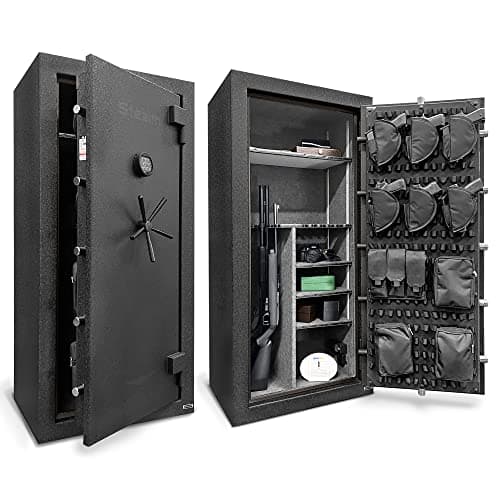
Best overall: a UL RSC with room for a collection
Stealth UL28
UL RSC7.5/10A maker-stated UL-listed RSC with 12-gauge steel, 4-way boltwork and a UL-listed lock, a documented burglary case (UL listing, published steel and boltwork) for a family that owns a real long-gun collection.
$1,799.99Amazon#ad · Price as of October 19, 2026 · Disclosure for the link to Stealth UL28
- Liberty SafeNo image
Best Liberty for maker-stated RSC evidence
Liberty Lincoln 25
UL RSC8.0/10The Liberty whose own page names its UL residential security container listing, built on a 10-gauge body with 3/8-in bars and a Liberty-claimed two-hour fire rating, for owners who want the clearest maker-stated burglary evidence in Liberty's range.
Check price · Amazon#ad · Price as of October 19, 2026 · Disclosure for the link to Liberty Lincoln 25
What to actually do, in order
- Bolt down the safe you already own, today.
- Change the factory code if you never did.
- Shorten the window: alarm, camera, lighting, and don't post the collection online.
- When you replace the safe, insist on a UL RSC listing and a published hard plate and bolt pattern — see our UL RSC gun safe roundup.
- Keep an inventory with serial numbers somewhere outside the safe, so a theft can be reported properly.
How we scored this
Every pick, checked against the paperwork
Here is exactly what goes into a score: whether an independent lab listed the safe (UL for burglary under UL 1037, UL or Intertek for fire), the maker's published steel, lock and bolt-down specs, the owner's manual, a dated CPSC recall search, and a public rubric applied the same way to every safe. Every figure links to where it came from, so you can confirm the pick in a couple of clicks and buy with confidence.
Scores are our editorial judgment of that documented evidence. Commissions never set a score or decide a pick. The rubric and its weights are published.
Questions
Frequently asked
Can someone break into a gun safe?
Is it hard to break into a cheap gun safe?
What is the weakest point of a gun safe?
Does a UL RSC rating mean a safe cannot be broken into?
Can a locksmith open a gun safe?
Keep reading
Related on Bolt & Vault
- UL RSC rating explainedThe five-minute test in detail, and how to verify a maker's claim.
- TL-15 vs TL-30 vs RSCWhat the commercial ratings add, measured in net working time.
- Gun safe hinges explainedWhy the hinges are not the weak point people assume.
- How to bolt down a gun safeThe highest-return thing you can do to your current safe.
- Best UL RSC gun safesEvery safe in our registry with an independent burglary listing.
Receipts
Sources
- UL — Residential Security Container Standard Revised (UL 1037, RSC Levels I-III)
- UL Standards & Engagement — UL 1037, Antitheft Alarms and Devices (scope)
- Safe and Vault Store — burglary ratings explained (RSC, B-rate, TL-15, TL-30)
- Liberty Safe — What Are Liberty Safes Made Of? Relockers, bolts and hard plates (checked 2026-10-10)
- Liberty Safe — Preventing Safe Tipping: Best Practices for Anchoring Gun Safes (checked 2026-10-10)
- Bureau of Justice Statistics — Firearms Stolen During Household Burglaries and Other Property Crimes, 2005-2010
- CPSC — recall database searched per brand on this page
Every figure above is traceable. Ratings come from the listing body or the maker's own spec pages (linked on every product), recall status from dated CPSC searches, and law summaries from official sources. Prices come live from Amazon so the number you see is the number you pay. Read the full method.