Safe Ratings Explained · Guide
Internal vs external gun safe hinges: the bolts decide the door, not the hinge
Cutting the hinges off a decent safe does not open it, because the door is held by bolts on all four sides. Hinge style is mostly a question of door swing, access and looks.
By Mike M.Updated Researched
#adReader-supported: we may earn a commission if you buy through our links, at no extra cost to you. It never decides a ranking. How we rate · Disclosure
"Gun safe internal vs external hinges" is one of the most common questions in this category and one of the few where the forum answer and the engineering answer disagree. The forum answer is that exposed hinges are a weakness because someone can cut them. The engineering answer is that a safe door is not held shut by its hinges at all.
Everything below comes from the makers' own published material, checked 2026-10-10. We do not test safes, and we are not going to speculate about attacks nobody has documented.
The short version
That is the whole argument, from a company with a commercial interest in both answers: both designs are UL-listed, and the external-hinge door stays on because the bolts hold it. Liberty's own conclusion is a preference question — classic looks and the widest swing on one side, a streamlined look and a safe that works in tighter spaces on the other.
Why the locking bolts settle it
Picture the door as a plug rather than a lid. When you turn the handle, bolts extend from the door edge into the body on the opening side, the top, the bottom and often the hinge side too. Cut the hinges and the door is still trapped by every bolt that is not on the hinge side. That is why the specification that matters is the bolt pattern: how many, what diameter, and on how many sides.
Look at what the safes in our registry publish. The Stealth UL28 lists twelve 1.25-inch solid steel bolts in a four-way pattern, of which four are deadbolts. The Steelwater HD593924 lists twenty 1.5-inch bolts, thirteen active and seven on the hinge side, covering all four sides. The Kodiak KGX5933W takes a different route: a patented anti-pry system that interlocks the door and body.
Those hinge-side bolts are the direct answer to the cut-hinge worry. A maker that puts seven of them on the hinge side has designed for exactly that attack.
What internal hinges actually give you
- Nothing to cut or torch from outside, which is the headline claim and the reason most buyers prefer them.
- Extra resistance to prying and door bending, per Liberty's own description.
- A built-in door stop. Liberty notes the hinge location acts as an automatic door stop that protects your walls — genuinely useful in a closet or a narrow room.
- A narrower swing, which is the cost: the door typically does not open as far, so reaching the far corners of the interior is harder.
What external hinges actually give you
- A wider door swing, often approaching 180 degrees, which means full access to the shelving and the door organizer.
- A removable door, which makes delivery into a tight space and any later lock service much easier. On a 900-lb safe going round a stairwell, that is not a small thing.
- A traditional look, usually with decorative hinge caps.
- Visible hardware, which is the aesthetic and psychological cost, and the source of the cut-hinge anxiety that is not borne out once bolts run on all four sides.
Relockers are the feature worth asking about instead
If you want to spend your attention on a door feature that genuinely separates safes, make it the relocker. Liberty's page describes it as a spring-loaded, automatically triggered mechanical system that secures the safe if someone drills, punches, torches or manipulates the lock or the door panel, and says it uses two: one inside the lock and a second connecting the lock's back plate to the opening mechanism. Its conclusion is blunt: "Many competitor's safes DO NOT have internal relockers inside their locks nor a second external relocker connected to the lock's back plate."
That is the kind of detail that decides whether an attack on the lock opens the safe or permanently locks it up. Several safes in our registry publish it: the Stealth UL series lists an internal re-locker behind a hard plate, and the Kodiak lists a spring-loaded relocker behind a triple hard plate. Our how hard is it to break into a gun safe page covers how these features interact with a timed attack, and the UL RSC explainer covers the test itself.
The published bolt patterns, side by side
Two of these three state a UL Residential Security Container listing. That listing is the thing that actually tests a door under attack: under UL 1037 at Level 1, a technician attacks the safe for five minutes with common hand tools (UL's notice on the standard). A safe that passes that test has already demonstrated what its hinge-and-bolt arrangement is worth, which is a better basis for a decision than counting hinges in a product photo.
Safes that publish the door detail
Our picks for this
Three safes that publish their bolt pattern
We rate transparency as part of the score. These three tell you how many bolts, what diameter and on which sides — which is the information the hinge debate is really about.
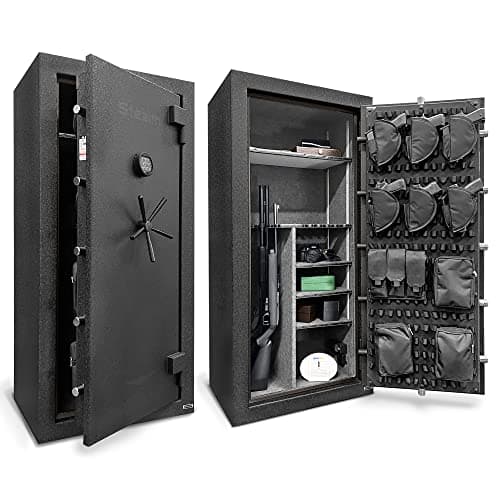
Best overall: a UL RSC with room for a collection
Stealth UL28
UL RSC7.5/10A maker-stated UL-listed RSC with 12-gauge steel, 4-way boltwork and a UL-listed lock, a documented burglary case (UL listing, published steel and boltwork) for a family that owns a real long-gun collection.
$1,799.99Amazon#ad · Price as of October 19, 2026 · Disclosure for the link to Stealth UL28
- SteelwaterNo image
Best heavy-steel pick for a slab floor
Steelwater Extreme Duty 39 (HD593924)
Access box5.8/10Heavy published steel (9 gauge, 20 bolts, 932 lb) with a maker-claimed 2-hour fire rating, for a garage or slab-floor owner who wants mass and plate over a listing.
Check price · Amazon#ad · Price as of October 19, 2026 · Disclosure for the link to Steelwater Extreme Duty 39 (HD593924)
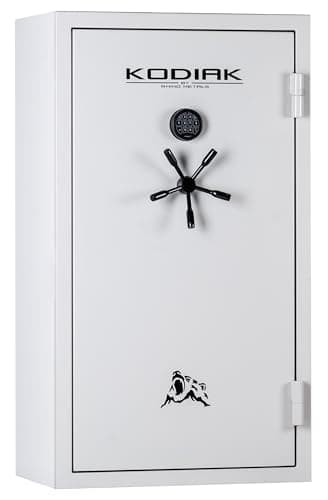
Best UL RSC for a large collection
Kodiak KGX5933W
UL RSC7.2/10Rhino Metals states a UL RSC certification and CA DOJ compliance for this 12-gauge, 41-long-gun Kodiak, making it the largest listed burglary-rated safe here for a family with a growing collection.
$2,098.00Amazon#ad · Price as of October 19, 2026 · Disclosure for the link to Kodiak KGX5933W
What to actually check before you buy
- Bolt count, diameter and number of sides. Four-way coverage with hinge-side bolts or deadbolts makes the hinge question moot.
- Whether there is a relocker, and how many. Ask the dealer if the page does not say.
- Hard plate behind the lock. This is what resists drilling at the only point worth drilling.
- Door swing against your room. This is where hinge style genuinely matters: measure the clearance in front of the hinge side before choosing, especially in a closet install.
- Whether the door can come off for delivery. If the route is tight, an external-hinge safe may be the only one that gets into the room; see how to move a gun safe.
And then do the thing that matters more than all of it: bolt the safe down. An unanchored safe can be tipped onto its back and worked on from the bottom, where there are no hinges, no bolts and no hard plate.
How we scored this
Every pick, checked against the paperwork
Here is exactly what goes into a score: whether an independent lab listed the safe (UL for burglary under UL 1037, UL or Intertek for fire), the maker's published steel, lock and bolt-down specs, the owner's manual, a dated CPSC recall search, and a public rubric applied the same way to every safe. Every figure links to where it came from, so you can confirm the pick in a couple of clicks and buy with confidence.
Scores are our editorial judgment of that documented evidence. Commissions never set a score or decide a pick. The rubric and its weights are published.
Questions
Frequently asked
Are internal hinges more secure on a gun safe?
Can a burglar cut the hinges off a gun safe to open it?
Why do some gun safes have external hinges?
What is a relocker on a safe?
Keep reading
Related on Bolt & Vault
- How hard is it to break into a gun safe?What a timed attack actually targets, and why it is not the hinges.
- UL RSC rating explainedThe five-minute hand-tool test that settles door-design arguments.
- Gun safe steel gauge explainedThe other construction number worth checking, converted into inches.
- How to bolt down a gun safeThe step that matters more than any door feature.
- Budget vs premium gun safesWhere door plate and bolt patterns sit in what the extra money buys.
Receipts
Sources
- Liberty Safe — What Are Liberty Safes Made Of? Internal and external hinges, relocker devices (checked 2026-10-10)
- UL — Residential Security Container Standard Revised (UL 1037 RSC levels)
- UL Standards & Engagement — UL 1037, Antitheft Alarms and Devices (scope)
- Stealth Safes — UL28 product page, bolt pattern and re-locker (checked 2026-10-10)
- Steelwater Gun Safes — HD593924 product page, 20-bolt pattern including hinge side (checked 2026-10-10)
- Rhino Metals — Kodiak KGX5933W product page, SafeX anti-pry system and relocker (checked 2026-10-10)
Every figure above is traceable. Ratings come from the listing body or the maker's own spec pages (linked on every product), recall status from dated CPSC searches, and law summaries from official sources. Prices come live from Amazon so the number you see is the number you pay. Read the full method.