Home & Fire Safes · Guide
What size home safe do I need? Start from the pile, not the catalogue
Cubic feet is the number makers advertise and the least useful one to shop by. Measure the stack you want protected, add the growth you can predict, then check the published interior dimensions against the awkward items.
By Mike M.Updated Researched
#adReader-supported: we may earn a commission if you buy through our links, at no extra cost to you. It never decides a ranking. How we rate · Disclosure

"What size safe do I need" is almost always answered with cubic feet, and cubic feet is the least informative number on the spec sheet. A 0.28 cu ft chest is 4.4 inches tall inside. A 0.44 cu ft wall safe is 3 inches deep. They have similar volumes and will hold completely different things. The useful method runs the other way round: start from what you own, convert that to a volume, then test the volume against published interior dimensions.
Every product figure below is the maker's published specification, checked 2026-10-17, and each brand carries a dated CPSC recall search on its card.
Step 1: put the inventory on a table
This takes fifteen minutes and it is the only step that reliably prevents buying the wrong safe. FEMA's Emergency Financial First Aid Kit is a solid checklist of what households actually need to be able to produce after a disaster: identification, property and insurance records, financial account information, medical and estate documents. Pull those, and add the physical valuables.
What surprises most people is how thin the genuinely irreplaceable pile is. Bank statements, tax returns and policy documents can be reissued or are already in a portal. Passports, birth and marriage certificates, naturalisation papers, deeds, titles, wills, military records, a backup drive and a handful of sentimental items are the core, and that is usually under a quarter of a cubic foot. Our what to keep in a fireproof safe guide goes through the categories properly.
Step 2: turn the pile into cubic feet
Be sceptical of advertised volume in one specific way: makers measure the interior shell, and the usable space is smaller once you account for the door mechanism, the shelf thickness and the fact that you cannot pack a safe to the walls if you want fire protection to work on the contents in the middle. Treat the published figure as about 85 percent usable.
Step 3: check the awkward items against the interior dimensions
Volume tells you nothing about whether a specific object fits. Four items catch people out, and all four are decided by published interior dimensions rather than cubic feet:
- Legal-size paper. 8.5 x 14 inches, so it needs a published interior over 14 inches in one direction. Most household safes are 12 to 13 inches wide inside. See legal-size documents.
- Hanging folders. Letter rails are about 12.25 inches; legal about 15.25. A fire file with a 12 inch interior takes letter and nothing wider.
- A handgun with a light or an optic. Published pistol-box interiors are often under 2 inches deep. Measure the widest point of the actual firearm.
- Ring binders and photo albums. A 2 inch binder needs about 12 x 11.5 inches of footprint and 2.5 inches of height; three of them is most of a cubic foot.
The size ladder, in plain terms
Four rungs cover nearly every household, and the step between each one roughly doubles the interior while roughly doubling or tripling the weight:
- 0.24 to 0.28 cu ft, 20 to 28 lb. A document chest. Passports, certificates, a drive, some cash. Grab-and-go, privacy lock.
- 0.5 to 0.9 cu ft, 55 to 110 lb. A small home safe. Documents plus jewellery, a handgun or medication, with a keypad and bolt-down hardware. The volume most households should buy.
- 1.2 to 2.0 cu ft, 85 to 130 lb. A full fire-and-water safe. Legal paper, binders, a camera body, a larger cash reserve.
- 2 to 4 cu ft, 190 lb and up. A burglary-rated home safe. Here you are buying steel and a listing, and interior volume comes along with it.
If your answer lands above that, you are shopping for a gun safe rather than a home safe, even if no firearms are involved: that is where 10 to 20 cu ft bodies live. Our gun safe size guide handles that end, including why advertised gun counts overstate real capacity.
Safes at each rung of the ladder
Our picks for this
One safe per rung, with the published interior
Four safes that bracket the sizes above, chosen because each one publishes its interior dimensions and names the lab behind its ratings where it has one.
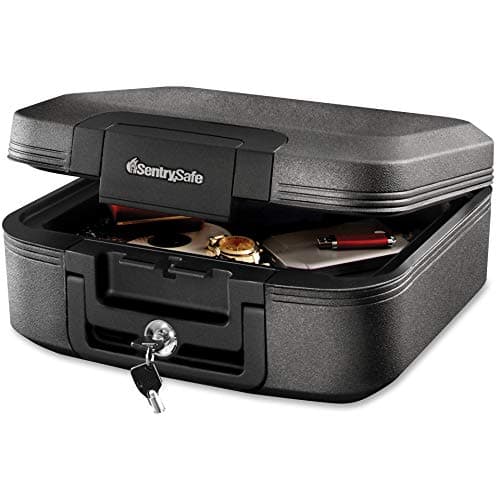
Best 1-hour UL fire chest
SentrySafe CFW20201
Fire chest6.3/100.28 cu ft and 20 lb, with a UL-classified hour at 1,700°F. Interior 4.4 x 12.8 x 8.5 in: folded legal paper, passports, a drive.
$86.82Amazon#ad · Price as of October 19, 2026 · Disclosure for the link to SentrySafe CFW20201
- SentrySafeNo image
Best compact fire safe with a backup key
SentrySafe FPW082HTC
Fire chest7.1/100.81 cu ft and 55 lb, UL-classified for an hour, with a genuine override key. Interior 9.6 x 12.4 x 11.5 in: stacked letter folders plus valuables.
Check price · Amazon#ad · Price as of October 19, 2026 · Disclosure for the link to SentrySafe FPW082HTC
- SentrySafeNo image
Best large fire and water safe
SentrySafe SFW205GQC
Fire chest7.5/102 cu ft and 125 lb, the only pick whose 14.8 in interior width takes a legal sheet flat. Six 1 in bolts and an ETL-verified water rating.
Check price · Amazon#ad · Price as of October 19, 2026 · Disclosure for the link to SentrySafe SFW205GQC
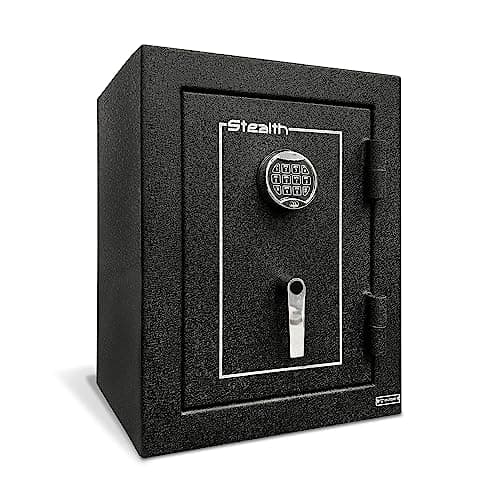
Best UL RSC home safe on Amazon
Stealth HS4
UL RSC5.6/10A maker-stated UL RSC burglary rating on a 12-gauge body, 191 lb, with a 21 x 15 x 13 in interior. This is the rung where you buy steel, not volume.
$1,199.99Amazon#ad · Price as of October 19, 2026 · Disclosure for the link to Stealth HS4
When to size up
Three situations where the next rung up is the right call:
- You are buying once. Safes are not upgraded often, and the cost per cubic foot falls as size rises. If the budget stretches, buy the volume now.
- You want fire protection to work on the contents. A packed safe puts paper against the hot inner wall. Air space is part of how the rating performs for the items in the middle; the published fire classes are measured on interior air temperature.
- Firearms are involved. Accessories, magazines, cleaning kit and ammunition take more room than the firearms themselves, and ammunition should not be crammed against a warming rod. See how to store ammo long term.
When bigger is actively worse
Size is not free, and three costs land on the household rather than the invoice:
- Weight on a floor. Above the ground floor, a heavy safe is a point load on joists built for a spread one. Run the check in can your floor support a gun safe before you order anything over a couple of hundred pounds.
- Placement. A bigger safe has fewer possible homes, and concealment matters: where to put a safe in your house covers the trade-offs.
- Humidity. A larger sealed interior needs a bigger desiccant unit, sized on cubic feet. The coverage figures on our dehumidifier picks run from 57 to 500 cu ft for exactly this reason.
The practical compromise most households end up at: one safe sized to the second rung, bolted down, with a small UL-classified chest inside it for the handful of items that are genuinely irreplaceable. That is cheaper than one large safe and it protects the important things better.
How we scored this
Every pick, checked against the paperwork
Here is exactly what goes into a score: whether an independent lab listed the safe (UL for burglary under UL 1037, UL or Intertek for fire), the maker's published steel, lock and bolt-down specs, the owner's manual, a dated CPSC recall search, and a public rubric applied the same way to every safe. Every figure links to where it came from, so you can confirm the pick in a couple of clicks and buy with confidence.
Scores are our editorial judgment of that documented evidence. Commissions never set a score or decide a pick. The rubric and its weights are published.
Questions
Frequently asked
What size home safe do most people need?
How many cubic feet is a stack of documents?
Is a bigger safe always better?
Should I buy one big safe or two small ones?
How much space should I leave inside a safe?
Keep reading
Related on Bolt & Vault
- Best small home safesIf the answer came out under one cubic foot, the shortlist is here.
- Best home safesThe main ranking, across sizes and ratings.
- What to keep in a fireproof safeBuild the inventory that sets the size.
- Gun safe size guideFor the larger end, and why gun counts overstate capacity.
- Best fireproof safes for legal sizeThe one dimension that overrides any cubic-feet calculation.
Receipts
Sources
- FEMA — Emergency Financial First Aid Kit (EFFAK): the household records checklist used for the inventory step
- SentrySafe — CFW20201 product page: 0.28 cu ft and published interior dimensions (checked 2026-10-17)
- SentrySafe — FPW082HTC product page: 0.81 cu ft, interior dimensions, override key (checked 2026-10-17)
- SentrySafe — SFW205GQC product page: 2 cu ft and a 14.8 in interior width (checked 2026-10-17)
- Stealth Safes — HS4 product page: UL RSC wording, 21 x 15 x 13 in interior, 191 lb (checked 2026-10-17)
- Safe & Vault Store — published explanation of the UL fire classes (interior air temperature)
- CPSC — recall database searched per brand on this page
Every figure above is traceable. Ratings come from the listing body or the maker's own spec pages (linked on every product), recall status from dated CPSC searches, and law summaries from official sources. Prices come live from Amazon so the number you see is the number you pay. Read the full method.