Safe Ratings Explained · Guide
Is a 30-minute fire rating enough? It depends on three things that are not the time
A half-hour rating is the entry point for independently classified fire protection. Whether it is enough depends on what is inside, who measured it, and whether the safe survives the floor collapsing.
By Mike M.Updated Researched
#adReader-supported: we may earn a commission if you buy through our links, at no extra cost to you. It never decides a ranking. How we rate · Disclosure
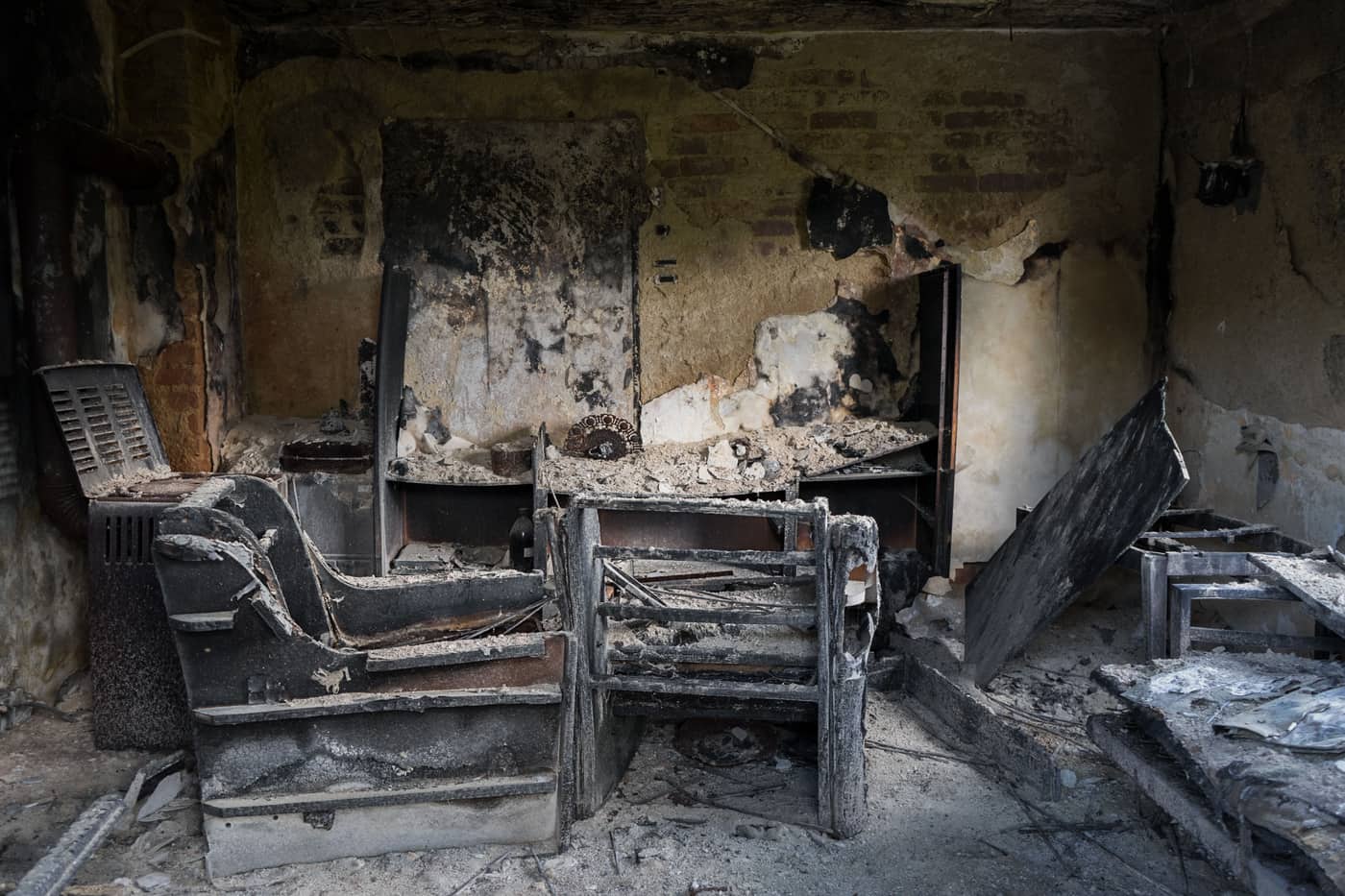
"Is a 30 minute fire rating enough" is a question we see asked constantly and answered badly, usually with an anecdote about how long house fires burn. We are not going to invent a number for that. What we can do is take the rating apart, show what the half hour is actually promising, and give you the three variables that change the answer more than the time does.
Everything below comes from the published standard, the labs that run the tests and the makers' own documentation, each linked where it is used and checked 2026-10-10.
The short answer, in one table
What 30 minutes actually means
A fire rating is four facts in one line, not one: the class (how hot the inside is allowed to get), the time, the furnace temperature, and who ran the test. Under UL 72, the standard for fire resistance of record protection equipment, the class number is the maximum interior temperature the device had to hold and the time is how long it held it while the furnace ran at a stated temperature. Safe and Vault Store's summary of fire ratings lays out the same structure.
So a 30-minute rating is not "your safe survives 30 minutes of fire." It is: in a furnace at the stated temperature, for 30 minutes, the inside stayed below the class limit. On the SentrySafe CHW20221 that is UL Classified for half an hour at up to 1,550°F. On the Honeywell 1103 it is UL certified for 30 minutes at up to 1,550°F. Those are directly comparable numbers, which is exactly why a classification is worth more than a maker's claim of twice the time. Our safe fire ratings explained walks through reading any label in this category.
The three things that matter more than the time
- The class, which depends on what is inside. Every rating on this page is a paper-grade rating: the interior may reach around 350°F, which paper survives and magnetic media, photographs and drives do not. A two-hour paper rating protects a hard drive no better than a 30-minute one. If you are storing digital media you need a media-specific rating; see fireproof safes for digital media.
- Who measured it. A UL classification or an ETL verification from Intertek means an outside lab ran the test. A manufacturer's unverified 90 minutes is a different kind of statement from a verified 30. Our are fireproof safes really fireproof page covers why.
- Whether it survives the fall. See below. This is the most under-discussed variable in the whole category.
The 30 / 60 / 120 ladder, side by side
Read the weight column with the fire column. The 30-minute chests weigh 20 to 27 lb; the hour-rated safe weighs 86.69 lb; the two-hour safe weighs 128.2 lb. Fire protection is insulation, and insulation is mass. That is the real trade when you step up the ladder, along with the fact that heavier safes are harder for a thief to carry — none of these carries a burglary rating, so weight is the only theft deterrent they have.
The drop test nobody mentions
A house fire does not politely leave your safe on a flat floor. Floors burn through, and the safe lands on whatever is below with its seals and hinges intact or not. Two picks here publish an ETL-verified impact test, and the figures are worth reading twice:
- SentrySafe SFW123GDC: the owner's manual states it was heated to 1,550°F, dropped 15 feet onto rubble, then reheated for 30 minutes.
- Master Lock STW123GTCML: heated to 1,850°F, dropped 30 feet into rubble, then reheated for 45 minutes, per its product documentation.
An impact-tested 30 minutes may well serve you better in a two-storey house than an untested hour. If your safe will live above ground level, ask about this before you ask about minutes.
When half an hour is genuinely enough
- Single-storey home, safe on a concrete slab. No fall, and the fire is fought from grade.
- Contents that are inconvenient rather than irreplaceable: copies, spare keys, warranty paperwork, a small amount of cash.
- You keep scans elsewhere. FEMA's Emergency Financial First Aid Kit is built around exactly this: a document inventory with copies held outside the house. A 30-minute chest plus an off-site copy beats a two-hour safe with no copy.
- Budget is the binding constraint. A 30-minute UL-classified chest is the cheapest genuine certification in the whole safe market; see best fireproof safes under $100.
When 30 minutes is not enough
- Irreplaceable originals: wills, deeds, naturalisation papers, birth certificates with no copy anywhere.
- Upper floors with no impact test. Prefer a longer rating or, better, an impact-tested one.
- Rural or long-response locations. Longer is simply more margin.
- Anything other than paper. Drives, discs, film and photographs need a lower interior limit, whatever the time says.
- If theft is also a worry. A 20-lb chest with a privacy key lock is not security at any fire rating. See best home safes.
Picks at each rating level
Our picks for this
One pick at each step of the ladder
Two hours with an impact test, one hour with an impact test, and two 30-minute UL chests — all four with ratings an outside lab measured rather than the maker.
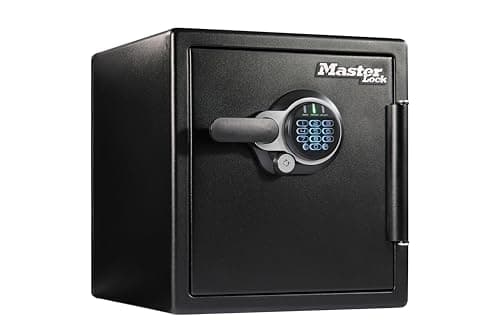
Best 2-hour UL fire rating
Master Lock STW123GTCML
Fire chest8.0/10UL classifies it for 2 hours at 1,850°F, Intertek (ETL) verifies its water resistance, a fire-impact drop test is documented (the product page and manual state different heights), and the maker says fire and water protection hold when bolted down: the pick when fire duration matters most.
$356.24Amazon#ad · Price as of October 19, 2026 · Disclosure for the link to Master Lock STW123GTCML
- SentrySafeNo image
Best all-round fire and water safe
SentrySafe SFW123GDC
Fire chest7.5/10A 1.23 cu ft steel-cased fire and water safe that UL classifies for 1 hour at 1,700°F and Intertek (ETL) verifies against 8 in of water for 24 hours: the evidence-backed default for papers, passports and USB drives.
Check price · Amazon#ad · Price as of October 19, 2026 · Disclosure for the link to SentrySafe SFW123GDC
Best budget fire and water chest
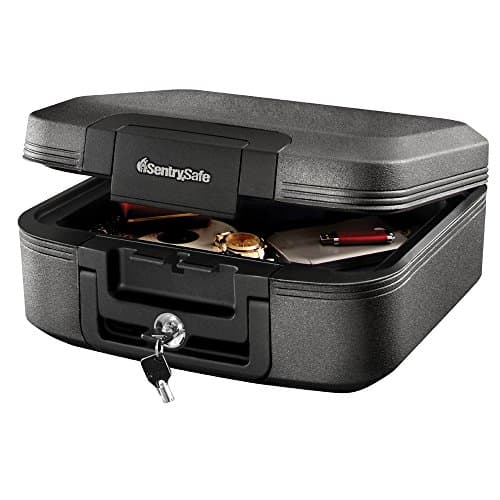
SentrySafe CHW20221
Fire chest5.6/10A 0.28 cu ft resin chest that UL classifies for 30 minutes at 1,550°F and ETL verifies against flood damage for 72 hours: a portable grab-and-go box for passports, birth certificates and a backup drive.
$62.99Amazon#ad · Price as of October 19, 2026 · Disclosure for the link to SentrySafe CHW20221
Best Honeywell fire chest
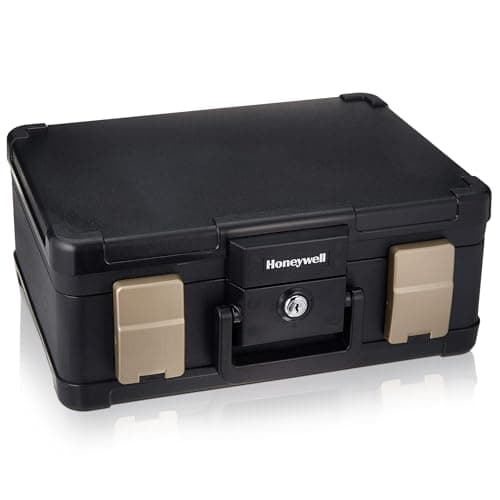
Honeywell 1103
Fire chest4.9/10A 0.24 cu ft chest whose 30-minute, 1,550°F fire rating the manual attributes to Underwriters Laboratories, with compression latches and a maker-claimed water seal: Honeywell's counterpart to SentrySafe's small chests.
$98.98Amazon#ad · Price as of October 19, 2026 · Disclosure for the link to Honeywell 1103
If you are choosing between a verified 30 minutes and an unverified two hours, take the 30. If you are choosing between a verified 30 minutes and a verified hour, buy the hour if the budget and the weight work, and spend the difference on copies kept somewhere else. Our what to keep in a fireproof safe guide covers what belongs inside either one.
How we scored this
Every pick, checked against the paperwork
Here is exactly what goes into a score: whether an independent lab listed the safe (UL for burglary under UL 1037, UL or Intertek for fire), the maker's published steel, lock and bolt-down specs, the owner's manual, a dated CPSC recall search, and a public rubric applied the same way to every safe. Every figure links to where it came from, so you can confirm the pick in a couple of clicks and buy with confidence.
Scores are our editorial judgment of that documented evidence. Commissions never set a score or decide a pick. The rubric and its weights are published.
Questions
Frequently asked
Is a 30 minute fire rating enough for documents?
What does a 30 minute fire rating mean on a safe?
Is a 2 hour fire safe worth it over a 1 hour?
Will a 30 minute safe protect a hard drive or photos?
Keep reading
Related on Bolt & Vault
- Safe fire ratings explainedThe four parts of any fire label, and how to compare two of them fairly.
- Are fireproof safes really fireproof?What the word covers, and the limits every rating has.
- Best fireproof safes under $100Where a genuine 30-minute UL classification is affordable.
- Best waterproof home safesThe second half of the job: water after the fire.
- What to keep in a fireproof safeWhich contents the class limit actually protects.
Receipts
Sources
- UL Standards & Engagement — UL 72, Fire Resistance of Record Protection Equipment (scope and classes)
- Safe and Vault Store — fire ratings explained (class, time and temperature structure)
- Intertek — ETL Verified mark, what a verified performance claim covers
- SentrySafe — CHW20221 product page, UL Classified 1/2 hour at 1,550°F (checked 2026-10-10)
- Honeywell Safes — 1103 fire chest product page, UL certified 30 minutes at 1,550°F (checked 2026-10-10)
- SentrySafe — SFW123GDC owner's manual (PDF): ETL impact test, 1,550°F, 15-foot drop, 30-minute reheat
- SentrySafe — STW123GTCML product page, UL 2-hour classification and impact test (checked 2026-10-10)
- FEMA — Emergency Financial First Aid Kit (EFFAK), document inventory and off-site copies (PDF)
Every figure above is traceable. Ratings come from the listing body or the maker's own spec pages (linked on every product), recall status from dated CPSC searches, and law summaries from official sources. Prices come live from Amazon so the number you see is the number you pay. Read the full method.