Setup & Safe Storage · Guide
Gun safe tax credits by state: what the statutes actually say
Almost every "gun safe tax credit" is really a sales-tax exemption, and at least one widely repeated entry expired at the end of 2024. Here is what we could verify in the states' own sources, with each one linked.
By Mike M.Updated Researched
#adReader-supported: we may earn a commission if you buy through our links, at no extra cost to you. It never decides a ranking. How we rate · Disclosure
Not legal advice. This page summarizes laws and regulations from the official sources linked in the text. Law summary checked . Laws change: confirm the current rules with your state's official source or an attorney before relying on them.
"Gun safe tax credit" is the phrase people search, and it is almost always the wrong phrase for what exists. What exists, where it exists at all, is a sales-tax exemption applied at the register by the retailer. You do not claim it on a return, there is no form, and it does not reduce your income tax.
This page lists only what we could read in a state's own statute or on its own tax-agency page, with the source linked and the date we checked it (2026-10-26). Where we could not verify a state's rule in an official source, we say so instead of repeating a list from another website — which matters here more than usual, because at least one entry that still circulates widely has expired.
It is an exemption, not a credit
That distinction has a practical consequence: because the benefit is applied by the retailer, the thing that goes wrong is the retailer not applying it. More on that below.
What we verified, state by state
Three states, each from the state's own source. This is not a claim that no other state has a program; it is a claim about what we could verify in an official source on 2026-10-26.
Washington: exempt, no price cap, no expiration
RCW 82.08.832 states that the retail sales tax "does not apply to sales of gun safes". The statute defines a gun safe as an enclosure specifically designed or modified to store a firearm and equipped with a padlock, key lock, combination lock or similar locking device. There is no price ceiling in the section and no expiration date in its text. Note the scope: it is written about safes, so a cable lock or a trigger lock bought on its own is a different question.
Virginia: exempt at $1,500 or less
Virginia Tax, the state's own tax agency, publishes the rule on its sales tax exemptions page: gun safes costing $1,500 or less are not subject to Virginia sales tax. Its definition is narrower than Washington's in one way and wider in another — the safe must be commercially available, designed for storing a firearm or ammunition, and secured by a digital or dial combination lock or a biometric mechanism, and a glass-fronted cabinet does not qualify. The agency cites Va. Code § 58.1-609.10.
Michigan: the statute expired at the end of 2024
This is the entry worth knowing about, because it is still listed as live on plenty of buying guides. MCL 205.54ll exempted the sale of a firearm safety device — defined to include a gun safe, gun case or lockbox opened by a key, combination or biometric means, and excluding glass-faced display cabinets — and the section set that exemption to run only through December 31, 2024.
We could not verify a later Michigan statute putting it back in force, so the honest reading on 2026-10-26 is that a Michigan buyer should expect to pay sales tax and should check the Michigan Treasury for a current taxpayer notice rather than trust a blog post. If you bought a safe in Michigan during 2024 and were charged tax, that is a question for the retailer and the Treasury, not for us.
The definition is the whole game
Every statute we read turns on a definition, and the definitions do not match each other. Four tests recur, and between them they decide whether the box in your cart qualifies:
- Is it a container, or a device on the gun? Washington's section is about safes. Michigan's expired section covered both safes and devices fitted to the firearm itself. A state that exempts "firearm safety devices" may cover a cable lock; a state that exempts "gun safes" may not.
- How does it lock? Virginia requires a digital or dial combination lock or a biometric mechanism. Washington accepts a padlock, key lock, combination lock or similar. A key-only box can pass in one state and fail in another.
- Can you see into it? Both Virginia and Michigan's expired text exclude glass-faced display cabinets. That is a real exclusion, not a technicality: display cabinets are the cheapest thing most buyers mistake for a safe, and we cover why in gun safe vs gun cabinet.
- What does it cost? Virginia's $1,500 ceiling is on the price you actually pay, so a discount can bring a safe under the line. Washington's statute has no ceiling at all.
Notice what is not in any of these definitions: a burglary rating, a fire rating, a steel gauge or a lab listing. A tax statute does not care whether the safe is any good. Nothing here replaces reading the evidence — the UL RSC listing is still the only burglary claim anyone measured, and UL's own notice on the standard describes what that test involves.
How to check your own state in five minutes
Because these rules change on legislative sessions and sunset clauses, the only answer that stays right is the method rather than the list:
- Search your state tax agency's own site for "firearm safety device", "gun safe" and "gun lock". Department of Revenue, Department of Taxation or Treasury, depending on the state. Agency pages are usually plainer than the statute.
- Then open the statute the agency cites and read the definition and any date. Sunset clauses live in the statute, not in the summary.
- Check for a price ceiling, and whether it applies before or after discounts.
- Check the date on whatever you are reading. A 2022 article about a 2024 sunset is worse than no information.
- If a sales-tax holiday is involved, note the window. Some states fold safety devices into a dated holiday rather than a standing exemption, which means the saving exists for a weekend rather than all year.
Safes that fit the usual definition
No safe is exempt because of its brand; it is exempt because of what it is and, in some states, what it costs. These three are from our own rankings and each meets the construction and locking tests that the statutes above describe — an enclosed container, not a glass-faced cabinet, opened by a combination or keypad. Whether a given purchase clears a price ceiling is a question about your receipt, not about the spec sheet, and we publish no prices: use the buy button for the current figure.
Our picks for this
Enclosed, combination or keypad-locked safes from our rankings
Chosen because each is an enclosed container with a combination or electronic lock rather than a display cabinet, which is the shape the statutes above describe. The tax rule is set by your state and your price, not by the model.
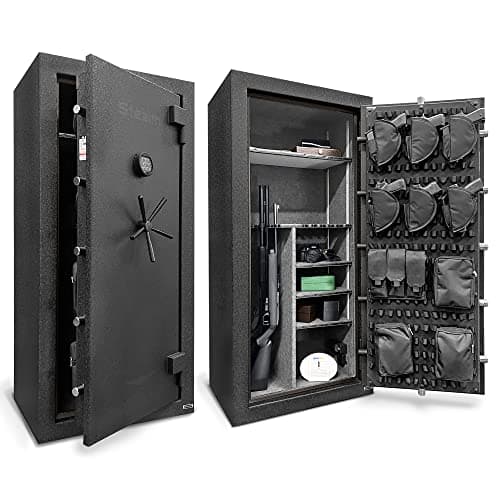
Best overall: a UL RSC with room for a collection
Stealth UL28
UL RSC7.5/10Our UL RSC pick: the maker states a UL RSC burglary listing, and it ships with an electronic lock and pre-drilled anchor holes. An enclosed steel body, not a cabinet.
$1,799.99Amazon#ad · Price as of November 3, 2026 · Disclosure for the link to Stealth UL28
- SentrySafeNo image
Best all-round fire and water safe
SentrySafe SFW123GDC
Fire chest7.5/10A UL-classified fire safe with a dial-and-keypad combination and an ETL-verified water rating, for buyers whose state writes its definition around combination locks.
Check price · Amazon#ad · Price as of November 3, 2026 · Disclosure for the link to SentrySafe SFW123GDC
- Winchester SafesNo image
Best compact safe with a backup key
Winchester Bandit 14
Access box4.8/10The compact end: an enclosed 14-gun safe with an electronic lock, for a buyer under a price ceiling. Winchester states no UL burglary listing for it.
Check price · Amazon#ad · Price as of November 3, 2026 · Disclosure for the link to Winchester Bandit 14
At the register: the part that goes wrong
Because the benefit is a retailer-applied exemption, the usual failure is a store charging tax on a safe that the state exempts. It has happened at national chains in exempt states. If you think you were charged tax on an exempt purchase:
- Keep the receipt, which is the only evidence of what was charged and what the price was after discounts.
- Ask the retailer first. Most refunds of incorrectly collected sales tax run back through the seller, not the state.
- Then ask the state agency how it handles over-collected tax. The procedure is a state question and the agency publishes it.
- Buying online? The exemption follows the ship-to state's rules, and marketplace sellers are not always configured for narrow exemptions. Check the tax line before you confirm the order.
One more practical note: if your state has a price ceiling, the accessories you add to the cart can matter. A safe at the line plus a dehumidifier may be billed as one transaction with two tax treatments. Our dehumidifier rankings and door organizer rankings cover the usual add-ons, and none of them is a safe for tax purposes.
What this page is not
This is a summary of published statutes and tax-agency pages, checked 2026-10-26, and it is not tax advice or legal advice. Tax rules change on legislative sessions, exemptions sunset, and the application to your purchase depends on facts we do not have. For a specific purchase, read your state's own current page or ask a tax professional.
If your reason for buying is the law rather than the discount, two other pages are more useful than this one: CA DOJ approved gun safes covers the one state standard that dictates what a safe must be, and storing guns safely with kids covers the storage practice that child-access prevention laws are written around.
How we scored this
Every pick, checked against the paperwork
Here is exactly what goes into a score: whether an independent lab listed the safe (UL for burglary under UL 1037, UL or Intertek for fire), the maker's published steel, lock and bolt-down specs, the owner's manual, a dated CPSC recall search, and a public rubric applied the same way to every safe. Every figure links to where it came from, so you can confirm the pick in a couple of clicks and buy with confidence.
Scores are our editorial judgment of that documented evidence. Commissions never set a score or decide a pick. The rubric and its weights are published.
Questions
Frequently asked
Is there a federal tax credit for a gun safe?
Which states exempt gun safes from sales tax?
Does Michigan still exempt gun safes from sales tax?
Do gun cabinets and gun locks qualify?
How is the price limit calculated where one applies?
The store charged me tax in an exempt state. Now what?
Keep reading
Related on Bolt & Vault
- Gun safe vs gun cabinetThe distinction the exemption statutes draw when they exclude glass-faced cabinets.
- CA DOJ approved gun safesThe state standard that dictates construction rather than price.
- Best gun safes under $1,000Where most buyers land under a state price ceiling.
- How to choose a gun safeThe five questions that matter more than the tax treatment.
- How to store guns safely with kidsThe storage practice the safety-device laws are built around.
Receipts
Sources
- Washington State Legislature — RCW 82.08.832, exemptions for sales of gun safes (checked 2026-10-26)
- Virginia Tax — Sales Tax Exemptions: gun safes costing $1,500 or less, definition and exclusions, citing Va. Code § 58.1-609.10 (checked 2026-10-26)
- Michigan Legislature — MCL 205.54ll: firearm safety device sales tax exemption and its December 31, 2024 expiration (checked 2026-10-26)
- Michigan Department of Treasury — current taxpayer notices (where a reinstated exemption would be published)
- UL — Residential Security Container Standard Revised (what a burglary listing tests, which no tax statute requires)
Every figure above is traceable. Ratings come from the listing body or the maker's own spec pages (linked on every product), recall status from dated CPSC searches, and law summaries from official sources. Prices come live from Amazon so the number you see is the number you pay. Read the full method.